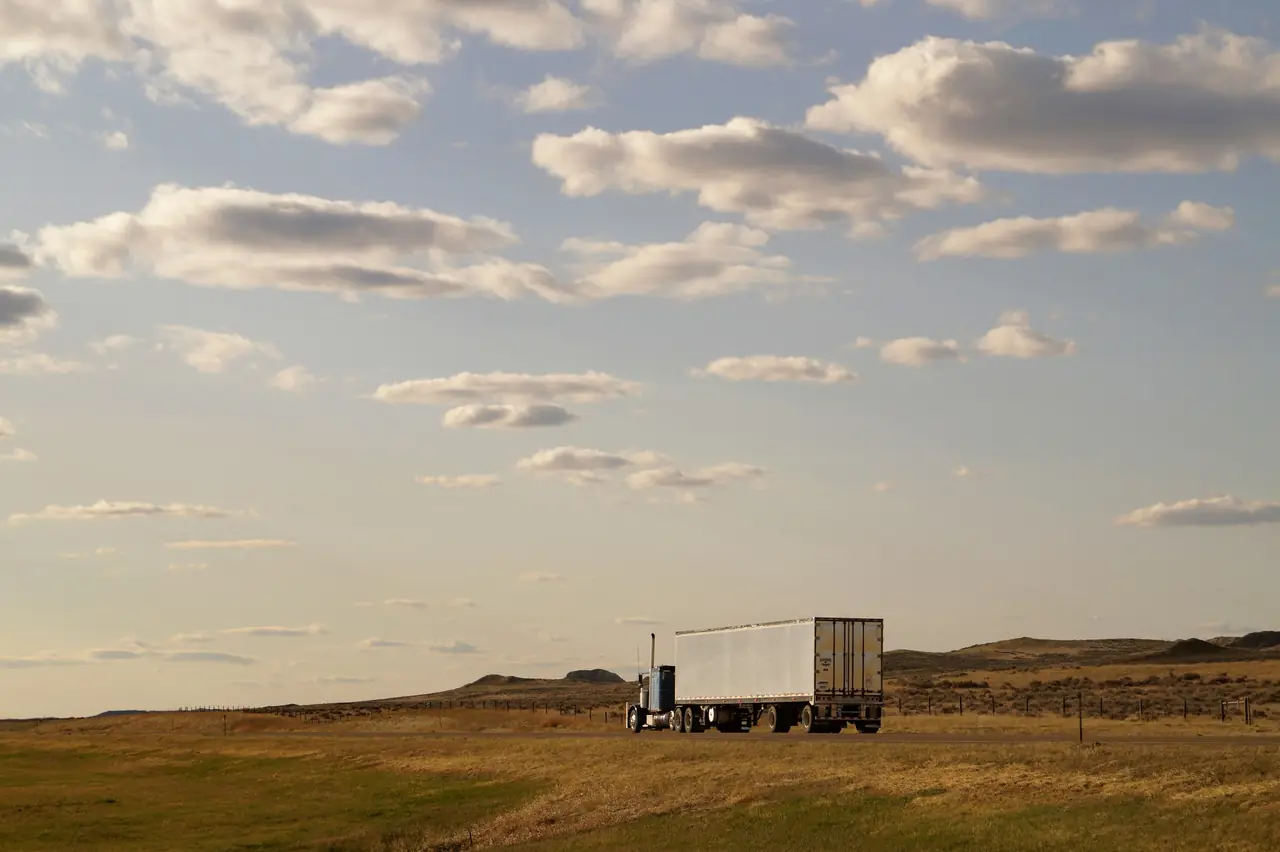
What a step deck trailer is
A step deck is an open trailer with two deck levels. The short upper deck sits over the tractor's fifth wheel at roughly flatbed height; then the deck steps down to a long lower deck that rides much closer to the road. That drop is the whole point. Lowering the deck lets taller freight stay under legal height without an oversize permit.
You will also hear it called a drop deck. It loads like a flatbed, from the side, from above or from the rear with ramps, and is secured with the same chains and binders.
Step decks are for shippers whose freight is too tall for a flatbed but not so tall or heavy that it needs heavy haul equipment. Equipment dealers, machine builders, farm equipment sellers and vehicle shippers use them. A step deck usually costs less than heavy haul gear, which is why it is the first trailer to check once freight goes past flatbed height.
Step deck compared with other trailers
Choose a step deck when freight is taller than a flatbed allows but under about 10 ft. Choose a flatbed below that height and an RGN or other heavy haul trailer above it, or when the freight is too heavy. Typical figures; exact numbers depend on the carrier and trailer.
| Trailer | Typical deck height | Typical freight height | Typical legal payload |
|---|---|---|---|
| Flatbed | About 5 ft | About 8 ft 6 in | Up to about 48,000 lb |
| Step deck | About 3 ft 6 in (lower deck) | About 10 ft | Up to about 46,000 lb |
| Double drop | 18 to 24 in (well 25 to 29 ft) | Taller still | About 40,000 lb legal |
| RGN | 18 to 24 in (well 24 to 29 ft) | Taller still, drive-on | 40,000 lb legal, more with permits |
| Landoll or tilt deck | Tilts to grade, 50 to 53 ft | Varies | About 45,000 lb legal |
The step deck gives up some payload and some deck length compared with a flatbed, and in exchange it gains about 18 inches of freight height (10 ft against 8 ft 6 in). For most tall machinery that is exactly the trade you need. The double drop and RGN go lower still, but their wells are shorter and their legal payload is lower, so they make sense only when the height demands it. Our trailer guide lists the full set of open-deck trailers with sizes and limits.
Step deck specs at a glance
A step deck comes in the same overall lengths as a flatbed, but most of its useful space is the lower deck. The typical figures below vary by carrier and trailer, so confirm them for any load near the limits.
| Measure | Typical figure |
|---|---|
| Overall length | 48 or 53 ft |
| Lower deck length | Usually 37 to 43 ft |
| Lower deck height | About 3 ft 6 in |
| Legal freight height, lower deck | About 10 ft |
| Payload | Up to about 46,000 lb |
Width is the same as any trailer on the National Network: the federal limit is 102 inches (opens in a new tab), and no state may impose more or less. Step deck decks are typically 8 ft 6 in wide, which is exactly 102 inches (8 x 12 + 6), so anything that overhangs the deck edge is wide and needs a permit.
Lower deck length is the number that most often decides whether a load fits. A 40 ft machine fits a 43 ft lower deck with a little room to spare, but not a 37 ft one. Measure the longest piece and ask for a trailer with enough lower deck to carry it.
Step deck versus flatbed height math
Height on an open deck is deck height plus freight height, and the step deck wins by lowering the first number. States set height limits; FHWA reports they range from 13.6 to 14.6 feet (opens in a new tab), and there is no federal limit. Planning to 13 ft 6 in keeps a load under the lowest of those.
| Trailer | Deck height | Freight height | Overall |
|---|---|---|---|
| Flatbed | About 5 ft | About 8 ft 6 in | 13 ft 6 in |
| Step deck, lower deck | About 3 ft 6 in | About 10 ft | 13 ft 6 in |
| RGN, 24 in deck | About 2 ft | About 11 ft 6 in | 13 ft 6 in |
| RGN, 18 in deck | About 1 ft 6 in | About 12 ft | 13 ft 6 in |
The arithmetic is 13 ft 6 in minus deck height. For a flatbed, 13 ft 6 in minus 5 ft leaves 8 ft 6 in. For a step deck, 13 ft 6 in minus 3 ft 6 in leaves 10 ft. Measure the tallest point of the freight as it will sit on the deck, including any blocking, skids or cradles underneath it, and compare. If it is over 8 ft 6 in but under about 10 ft, a step deck usually keeps it legal without permits.
The upper deck and the step
The upper deck is the short section over the tractor, and it is planned like a flatbed. It sits higher than the lower deck, so freight there is held to flatbed heights of about 8 ft 6 in. On a 53 ft trailer with a 43 ft lower deck, the arithmetic leaves about 10 ft of upper deck (53 minus 43).
That space suits shorter freight riding with a tall piece: crated parts or attachments taken off a machine. A common mistake is assuming the whole trailer gives 10 ft of clearance; only the lower deck does.
The step itself is a vertical drop at the front of the lower deck. Freight cannot bridge it, so a piece longer than the lower deck cannot simply hang forward over the upper deck. If the longest item is longer than the lower deck, look at a longer step deck or another trailer. When you send dimensions, say which pieces can ride on the upper deck and which must ride low.
When to go RGN or lowboy
A step deck tops out at about 10 ft of freight and about 46,000 lb. Past either limit, the load needs heavy haul equipment.
An RGN (removable gooseneck) has a well about 24 to 29 ft long that sits 18 to 24 in off the road. The front detaches so equipment drives straight onto the deck, which suits tracked machines that cannot easily be lifted. A lowboy has a similar well of about 24 to 29 ft and carries about 40,000 lb legal. A double drop has a well of about 25 to 29 ft, 18 to 24 in off the road.
Using the height math, a deck of 18 to 24 in leaves about 11 ft 6 in to 12 ft of freight under 13 ft 6 in. Taller or heavier than that, the load needs permits. Under FHWA's permit guidance (opens in a new tab), states issue them, not the federal government, and only for nondivisible loads: freight that would take more than 8 work hours to dismantle or would be ruined by it.
Weight limits and where weight sits
A step deck's typical payload, up to about 46,000 lb, is a little below a flatbed's because the dropped frame is heavier. The legal limits that create that ceiling are the same for every truck: a federal gross limit of 80,000 lb (opens in a new tab), 20,000 lb on a single axle, 34,000 lb on a tandem, and the bridge formula, which can require a lower gross depending on axle count and spacing.
Placement matters more on a step deck than on most trailers, because its typical freight is one or two heavy machines. A machine placed near the step puts more weight toward the tractor; one near the rear loads the trailer tandem. A single machine of 30,000 lb in the wrong spot can push one tandem past 34,000 lb even though the gross is legal.
Send the weight of each piece, and where its weight is concentrated if the machine is unbalanced. The carrier will say where it needs to sit.
Typical step deck freight
Step deck freight is mostly freight that is tall, heavy and in one piece. The common families:
| Freight | Why a step deck | Watch point |
|---|---|---|
| Machinery and production equipment | Too tall for a flatbed | Attachment points, piece weight |
| Construction equipment | Tall cab or boom, drive-on | Ramps, 393.130 rules |
| Farm equipment | Tall and often wide | Width over 102 in |
| Vehicles and trucks | Drive-on with ramps | Tiedown points on the vehicle |
| Tall crates and skids | Over 8 ft 6 in | Measure including skids |
Farm and ag equipment is seasonal, with dealers moving machines ahead of planting and harvest; our produce and agriculture page covers that side. Plant moves and new equipment deliveries are covered under manufacturing. For vehicles, fleet trucks and parts on open decks, see automotive. Tall crates are the freight most often misjudged: a crate on a skid can measure under 10 ft on paper and come in over it once the skid and blocking are counted. Our glossary has a plain definition of a step deck if you need one. Rental fleets and contractors often move the same machines between the same yards and job sites; if a run repeats, it can be priced as a dedicated lane.
Ramps, forklifts and cranes
How the freight gets onto the deck decides which step deck you need. A step deck loads from the side or the rear, and the lower deck height helps both.
- Forklift from the side. The most common method for crates and skids. Check the forklift can lift the heaviest piece at full reach.
- Crane from above. Used for heavy machinery and anything without forklift pockets. Book the crane time with the truck so the driver is not waiting.
- Driven on with ramps. Wheeled and tracked equipment can drive up ramps onto the lower deck from the rear. Many step decks carry ramps, but not all of them, and ramps have weight ratings of their own.
- Loading dock. Some sites can load the lower deck from a dock or a raised pad at the right height.
Ask for ramps when you quote and say what the machine weighs. If ramps are needed at both ends, confirm the receiver has room behind the trailer to drive off.
Securing machinery and vehicles
Step deck loads are secured under the same federal rules as flatbed freight. The securement system must meet the 393.102 (opens in a new tab) performance criteria: working load limits able to withstand 0.435 g forward, 0.5 g rearward and 0.25 g lateral, and breaking strength able to withstand 0.8 g forward and 0.5 g rearward and lateral. For a 30,000 lb machine, 0.8 x 30,000 = 24,000 lb of forward force.
Two general rules set the minimum. Under 393.106 (opens in a new tab), the tiedowns' aggregate working load limit must be at least half the cargo weight, so 15,000 lb for that machine. Under 393.110 (opens in a new tab), an article over 10 ft long needs two tiedowns plus one for every additional 10 ft or part of it, unless it is blocked by a headerboard.
Heavy equipment and machinery have their own section, 393.130 (opens in a new tab). Accessory equipment such as booms, buckets and blades must be lowered and secured, and the machine is tied down at its front and rear. Tell us if the machine has rated tiedown points and where they are.
Tarps on a step deck
A step deck has no roof or sides, so freight that must stay dry needs a tarp. Tarping a step deck is harder than tarping a flatbed. The freight is taller, the shapes are irregular, and the tarp has to cover a load that rises well above the driver's reach from the deck.
The common types are the same as on a flatbed: lumber tarps for tall loads, steel tarps for lower ones, and smooth side tarps for freight that must arrive clean. On machinery, tarps also need edge protection wherever they cross sharp corners, or wind will cut them open on the highway.
Some freight should not be tarped at all. Machines with exposed exhaust, fragile panels or sensors may be better shrink-wrapped at origin or left uncovered if they are built for outdoor use. Tell us which applies, because tarping is normally priced as an accessorial and the carrier needs to bring the right tarps. If the receiver requires covered freight, put that on the quote request.
What drives a step deck rate
Step deck rates move with the same supply and demand as other open-deck freight, with a few factors that weigh more heavily. The main ones:
- Equipment scarcity. There are fewer step decks than flatbeds in most markets, so tight local supply pushes the rate more quickly.
- Lane balance. A step deck going into an area with little outbound open-deck freight may run back empty, and the rate carries those miles.
- Seasonality. Construction and farm equipment move ahead of the building and planting seasons, and demand for open decks rises with them.
- Distance. Longer runs cost more in total; short runs carry proportionally more loading time.
- Accessorials. Ramps, tarps, extra securement, detention while waiting for a crane or forklift, and extra stops all add.
- Size and weight. A load near the limits narrows the choice of trailers; a load over them adds permits, and possibly heavy haul equipment.
A step deck usually costs less than heavy haul gear, so if a load can be made to fit one, that is often the cheapest legal option.
What to send for a step deck quote
A step deck quote turns on dimensions, so the more exact the numbers, the better the rate and the fewer surprises at the dock. Send:
- Pickup and delivery city, state and ZIP, with dates and hours.
- What the freight is: make and model for machinery and vehicles.
- Length, width and height of each piece, measured at the tallest and widest point.
- Weight of each piece, and where the weight is concentrated.
- Whether it is crated, on skids, on a cradle or bare.
- How it loads and unloads: forklift, crane, ramps or dock.
- Whether ramps are needed, and the machine's weight for the ramp rating.
- Tarp requirement and type.
- Which pieces can ride on the upper deck.
- Any attachments that come off for shipping.
If the dimensions sit near the step deck limits, we will tell you whether a flatbed, a step deck or an RGN fits. A quote costs nothing and there is no obligation to book.
How Powerhaul handles step deck loads
A step deck drops the main deck so taller freight stays under legal height. It is the move for machinery, vehicles and equipment that will not clear on a flatbed, and it usually costs less than heavy haul gear.
We handle machinery and equipment, vehicles and ag equipment, ramps on request, tall crates and skids, tarped loads, and side and end loading. If the freight is taller than about 8 ft 6 in on a flat, a step deck usually keeps it legal without permits. Many step decks carry ramps; ask for them when you quote and we will book a truck that has them.
You get one contact, the person who books the load and answers when it changes. Every carrier is verified against FMCSA records, insured and approved by our compliance team before it sees a load. Pricing is all in, with accessorials such as ramps and tarps spelled out up front, and the signed proof of delivery and invoice arrive together once the load delivers.
Common step deck problems and fixes
Step deck problems almost always come down to a measurement or a piece of equipment nobody confirmed. The usual ones:
- Freight taller than measured. An exhaust stack, cab light or skid adds inches. Measure the tallest point as the freight will sit on the deck.
- Lower deck too short. A 40 ft machine does not fit a 37 ft lower deck. Ask for the lower deck length you need.
- No ramps. The machine drives on, but the truck arrives without ramps. Ask for ramps when you quote.
- Ramps too light. Ramps have their own weight ratings. Give the machine weight.
- Axle overload. One heavy machine placed near the rear overloads the trailer tandem. Send piece weights and balance points.
- Attachments left on. Buckets and booms must be lowered and secured under 393.130, and some must come off to stay under height.
- Wide load discovered at pickup. Anything wider than 102 inches needs permits. Measure the widest point, including mirrors and steps.
Measure twice and confirm loading gear at both ends, and a step deck load usually goes exactly as planned.