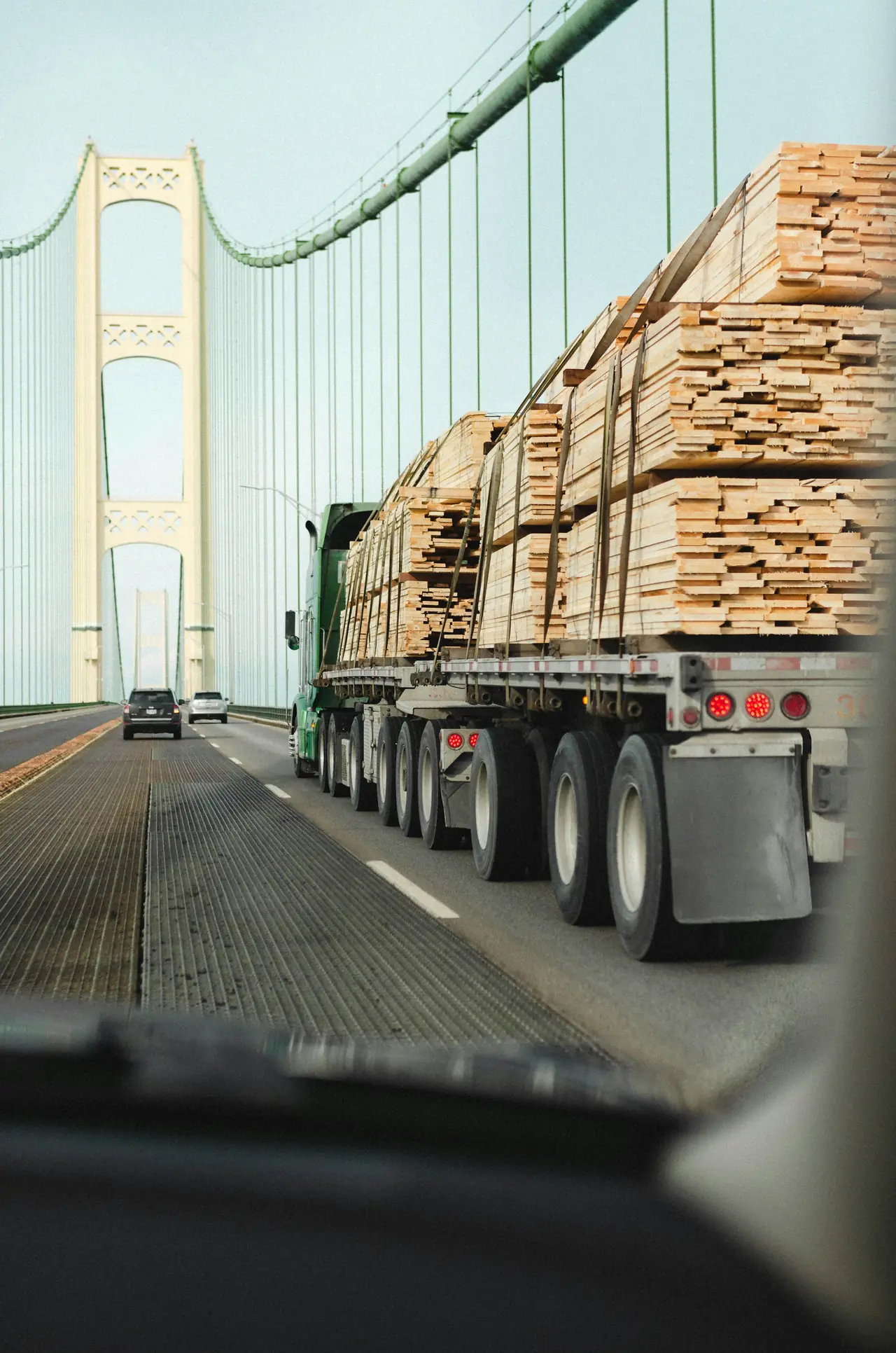
What flatbed shipping is
Flatbed shipping moves freight on an open trailer deck with no sides and no roof. Because nothing is in the way, the freight can be loaded from either side by forklift, from above by crane, or from the end. That makes the flatbed the default for anything that will not go through van doors: steel, beams, lumber, pipe, machinery and building materials.
The trade-off is that the trailer offers no protection and no walls to hold the load in place. Everything that keeps the freight on the truck, chains, straps, binders, blocking and edge protection, is added by the driver and is governed by federal securement rules. Everything that keeps it dry is a tarp.
Flatbed freight mostly ships as a full truckload, though partial flatbed loads are common for smaller steel and building material orders. Shippers range from mills and lumber yards to equipment dealers and plants moving machinery.
Flatbed compared with other open decks
Choose a flatbed when the freight is under about 8 ft 6 in tall, within legal width and needs side or top loading. Move to another open deck when height, length or weight pushes past what a flat can carry legally. The figures are typical; exact numbers depend on the carrier and trailer.
| Trailer | Typical deck or well | Typical freight height | Typical legal payload |
|---|---|---|---|
| Flatbed | 48 or 53 ft, deck about 5 ft high | About 8 ft 6 in | Up to about 48,000 lb |
| Step deck | Lower deck about 43 ft, about 3 ft 6 in high | About 10 ft | Up to about 46,000 lb |
| Conestoga | 48 or 53 ft, rolling tarp frame | About 8 ft inside | About 42,000 lb |
| Stretch flatbed | About 48 ft, extends to about 80 ft | Flatbed height | About 43,000 lb |
| RGN | Well about 24 to 29 ft, 18 to 24 in high | Tallest legal option | 40,000 lb legal, more with permits |
Too tall for a flat usually means a step deck, which buys about 18 more inches of freight height (10 ft against 8 ft 6 in) for a little less payload. Freight that is too long for 53 ft, such as long beams or poles, goes on a stretch flatbed. Freight that must stay dry but loads from the side often goes on a conestoga instead of a tarped flat. The heaviest and tallest machinery needs an RGN, and once you are on an RGN you are usually also talking about permits. The trailer guide lists every trailer with its sizes and limits.
Flatbed specs and height math
A flatbed's deck sits about 5 ft off the road, and that one number explains most of what you can ship on it. The typical figures, which vary by carrier and trailer:
| Measure | Typical figure |
|---|---|
| Length | 48 or 53 ft |
| Deck width | 8 ft 6 in |
| Deck height | About 5 ft |
| Legal freight height | About 8 ft 6 in |
| Payload | Up to about 48,000 lb |
The height math is simple addition. A deck of about 5 ft plus freight of 8 ft 6 in gives 13 ft 6 in overall. States set height limits, and FHWA reports they range from 13.6 to 14.6 feet (opens in a new tab), so 13 ft 6 in is a planning height that clears the lowest of them. Freight taller than about 8 ft 6 in on a flat either needs a lower deck or a height permit.
Width works the same way. A deck of 8 ft 6 in is 102 inches (8 x 12 + 6), exactly the federal width limit, so anything that hangs over the side of the deck is wide and needs a permit.
Weight limits on an open deck
Weight on a flatbed is limited the same way as on any truck: the federal gross limit is 80,000 lb (opens in a new tab) for tractor, trailer and freight together. Within that, a single axle may carry 20,000 lb and a tandem axle 34,000 lb, and the bridge formula, W = 500 (LN/(N-1) + 12N + 36), can require less depending on the number of axles and how far apart they are.
Where the weight sits matters more on a flatbed than in a van, because flatbed freight comes in a few heavy pieces rather than many light ones. One coil in the wrong spot can overload the trailer tandem even when the gross is well under the limit.
That is why the payload figure, up to about 48,000 lb, is a typical figure and not a promise. Send the weight of each piece, not just the total, and the carrier can tell you where it has to go.
Securement performance rules
Federal cargo securement rules live in 49 CFR 393 Subpart I, and they set a performance standard first, then specific requirements. Under 393.102 (opens in a new tab), the securement system has to hold the cargo against set forces, measured in g, multiples of the cargo's own weight.
| Direction | Breaking strength must withstand | Working load limits must withstand |
|---|---|---|
| Forward | 0.8 g | 0.435 g |
| Rearward | 0.5 g | 0.5 g |
| Lateral | 0.5 g | 0.25 g |
In plain terms, the system must be able to hold the cargo against a forward force equal to 80 percent of its weight, the kind of load a hard stop produces. For 40,000 lb of steel, 0.8 x 40,000 = 32,000 lb of forward force that the chains, blocking and friction have to resist together.
Working load limit (WLL) is the rated everyday capacity of a chain, strap or binder, well below its breaking strength. The driver is responsible for securement on the road, but how you package the freight decides how easy it is to secure.
How many tiedowns a load needs
Two rules set the minimum, and the load must meet both. The first is strength: under 393.106(d) (opens in a new tab), the aggregate working load limit of the tiedowns must be at least one-half the weight of the article or group of articles. The second is count, under 393.110 (opens in a new tab), for articles not blocked against forward movement by a headerboard or other blocking:
| Article length and weight | Minimum tiedowns |
|---|---|
| 5 ft or less, 1,100 lb or less | 1 |
| 5 ft or less, over 1,100 lb | 2 |
| Over 5 ft, up to 10 ft | 2 |
| Over 10 ft | 2, plus 1 for every additional 10 ft or part of it |
Worked example: a bundle of pipe 24 ft long weighing 12,000 lb. Count rule: 24 minus 10 leaves 14 ft beyond the first 10 ft, which is one full 10 ft plus a fraction, so 2 + 2 = 4 tiedowns. Strength rule: half of 12,000 is 6,000 lb, so those tiedowns must add up to at least 6,000 lb of WLL. If four straps do not reach 6,000 lb combined, the driver adds more until they do.
Steel coils and the coil rule
Metal coils have their own section, 393.120 (opens in a new tab), for coils of 5,000 lb or more, alone or grouped. Coils are heavy and want to roll, so requirements depend on how the coil sits:
- Eyes crosswise (the hole runs across the trailer, so the coil could roll forward or back): the coil needs an anti-roll device such as timbers, chocks, wedges or a cradle. Nailed blocking or a nailed wood cradle alone is prohibited, and crossing tiedowns in an X pattern is prohibited.
- Eyes vertical, single coil (the hole points up): two diagonal tiedowns crossing the eye, plus one transverse tiedown over the eye, with blocking or friction mats against forward movement.
- Eyes lengthwise (the hole runs along the trailer) has its own tiedown and blocking pattern in the same section.
Tell us the eye orientation, the weight of each coil, and whether coils sit on skids or cradles, so the carrier brings the right dunnage. Our steel and metals page covers coil, plate and bar freight in more detail.
Lumber, machinery and pipe rules
Beyond coils, Subpart I has commodity-specific sections for common flatbed freight. They add to the general rules in 393.102 through 393.110; they do not replace them.
| Section | Commodity |
|---|---|
| 393.118 (opens in a new tab) | Dressed lumber and similar building products |
| 393.122 | Paper rolls |
| 393.124 | Concrete pipe |
| 393.130 (opens in a new tab) | Heavy vehicles, equipment and machinery |
Dressed lumber and similar building products such as plywood, drywall and engineered beams are usually shipped in bundles, and 393.118 governs how bundles are tied down when stacked side by side or on top of one another. Heavy equipment and machinery under 393.130 must have its accessory parts, such as booms and blades, lowered and secured, with tiedowns attached at the machine's front and rear.
These rules are why the shipper's information matters. A dealer who says "a loader" leaves the carrier guessing; one who sends the make, model, weight and dimensions lets the driver plan chains and binders before arriving. For bundles of lumber, wallboard and other products, see building materials.
Tarps and keeping freight dry
A flatbed has no roof, so a tarp is the only weather protection your freight gets. Three common types, chosen by the freight:
| Tarp type | Typical use |
|---|---|
| Lumber tarp | Tall bundled loads; drapes over the top and down the sides |
| Steel tarp | Lower loads such as coils, plate and machinery |
| Smooth side tarp | Freight that must look clean on arrival, or that a standard tarp would scuff |
The carrier normally supplies tarps, and the requirement goes on the rate confirmation so nobody finds out at the dock that the truck has none. Tarping takes time and labor, so it is usually priced as an accessorial. Tell us early if the freight cannot get wet, rust or stain, or if the receiver requires covered loads. Edge protectors keep chains from cutting both the tarp and the cargo.
If your freight needs to stay dry but fits under about 8 ft inside height, a conestoga, with its rolling tarp frame, can be easier than tarping by hand.
Oversize loads and permits
A load is oversize when it is wider than 102 inches, taller than the state's height limit, or longer than state rules allow, and overweight when it exceeds legal weights. The federal government issues no oversize or overweight permits; according to FHWA's permit report (opens in a new tab), states do, and you have to contact every state on the route.
Permits are only for nondivisible loads: freight that would take more than 8 work hours to dismantle, or that would be ruined for its purpose if taken apart. A machine that is too wide qualifies; a stack of plate that could simply be split across two trucks does not.
Each state sets its own rules for routes, travel times, signs and escorts, so a load crossing three states needs three permits that agree. Permits also fix the route.
Send exact dimensions and weight, including the heaviest piece. Planning starts with whether the load can be made legal, often on a step deck or RGN, before going to permits.
Roadside inspections and Roadcheck
Flatbed loads are inspected at the roadside more visibly than vans, because securement can be checked from the shoulder. CVSA's International Roadcheck is an annual 72-hour, high-volume inspection event, mostly North American Standard Level I inspections, which follow a 37-step procedure.
The 2025 Roadcheck (opens in a new tab), held May 13 to 15, ran 56,178 inspections. Of the vehicles inspected, 18.1% were placed out of service, as were 5.9% of drivers. The 2026 event (opens in a new tab) ran May 12 to 14 with cargo securement as its vehicle focus, which put flatbed tiedowns directly in the spotlight.
The event runs each spring, but inspections happen all year. A load placed out of service for securement sits until it is fixed, often with a missed appointment as a result. Loads that are packaged with flat bearing surfaces, banded properly and placed where the driver asked are faster to secure correctly and less likely to be flagged.
Typical flatbed freight
Most flatbed freight falls into a few families, each with its own handling habits.
| Freight | Usual loading | Watch point |
|---|---|---|
| Steel coils, plate, bar and pipe | Overhead crane or heavy forklift | Weight placement, coil rule, edge protection |
| Lumber and building products | Forklift from the side | Bundle tiedowns, tarps |
| Machinery and equipment | Crane, forklift or driven on | Height, attachment points, 393.130 |
| Precast and concrete pipe | Crane | Blocking, 393.124 |
| Tall crates and skids | Forklift | Height over about 8 ft 6 in |
Steel is the heaviest and densest freight on the list, so it weighs out long before it uses the deck. Lumber and building materials take more deck space and almost always need tarps. Machinery is the freight most likely to push past flatbed height, and precast concrete is the most likely to need a crane at both ends. For plant equipment and finished goods on open decks, see manufacturing.
A common short-haul example is Houston to Dallas, about 240 miles on I-45, a run one driver can complete the same day within the 11-hour driving limit. Our Houston to Dallas flatbed lane guide covers that run.
What drives a flatbed rate
Flatbed rates depend on the same supply and demand as other truckloads, plus the extra work and gear open-deck freight needs. The main factors:
- Seasonality. Construction and building activity is strongest in warmer months, and flatbed demand tends to follow it.
- Lane balance. Outbound lanes from mills and lumber regions are busy; lanes back in may be thin, so the rate carries the empty miles.
- Equipment scarcity. Specialized gear such as step decks and conestogas costs more where it is scarce.
- Distance. Longer runs cost more in total; short runs carry proportionally more loading and securement time.
- Accessorials. Tarps, extra chains or dunnage, detention while waiting for a crane, and multiple pickups all add to the bill.
- Permits and escorts. Oversize loads add permit costs for every state and sometimes escort vehicles.
The cleaner the information at quote time, the fewer of these appear as surprises.
What to send for a flatbed quote
A flatbed quote needs more detail than a van quote, because the carrier is planning securement and sometimes permits. Send:
- Pickup and delivery city, state and ZIP, with dates and hours.
- Commodity, and how it is packaged (bundled, crated, on skids, loose).
- Number of pieces, and the length, width, height and weight of each.
- Total weight.
- How it loads and unloads: forklift, overhead crane or driven on, at both ends.
- Tarp requirement and type: lumber, steel or smooth side.
- For coils: weight per coil and eye orientation.
- For machinery: make, model, and whether attachments come off.
- Any piece wider than 8 ft 6 in or taller than about 8 ft 6 in.
- Receiver rules, such as covered loads only or delivery by appointment.
If the dimensions put the freight near flatbed limits, we will tell you which trailer keeps it legal. A quote costs nothing and there is no obligation to book.
How Powerhaul handles flatbed loads
Open-deck freight is only as good as its securement. We match the load to a carrier with the right chains, straps, edge protection and tarps, and settle the plan before pickup so the driver is not guessing at the dock.
We handle steel coils, plate and pipe, lumber and building products, machinery and equipment, tarped loads, crane and forklift loading, and oversize on request. Tarps are covered: lumber, steel and smooth side. Tell us what the freight needs and it goes on the rate confirmation.
Oversize takes planning. Send dimensions and weight and we will tell you what it takes.
You get one contact, the person who books the load and answers when it changes. Every carrier is verified against FMCSA records, insured and approved by our compliance team before it sees a load. Pricing is all in, with accessorials such as tarps spelled out up front, and the signed proof of delivery and invoice arrive together once the load delivers.
Common flatbed problems and fixes
Most flatbed trouble comes from information that arrived too late. The usual ones:
- No tarps on the truck. The receiver wants a covered load and the driver has none. Put the tarp type on the quote request.
- Freight taller than planned. A machine measured without its cab or exhaust stack comes in over 8 ft 6 in. Measure the tallest point.
- Wrong loading gear. One end has a forklift, the other only a crane. Confirm equipment at both ends.
- Axle overload. One heavy piece placed in the wrong spot. Send piece weights so the driver can plan placement.
- Not enough tiedowns. Strength and count rules both apply, so the plan needs accurate weights and lengths.
- Crane delays. Waiting for a crane turns into detention. Book the lift time with the truck.
- Overhang discovered at the dock. Anything past 102 inches wide needs a permit. Measure before booking.
Planning these before pickup costs nothing; fixing them at the dock costs a day.