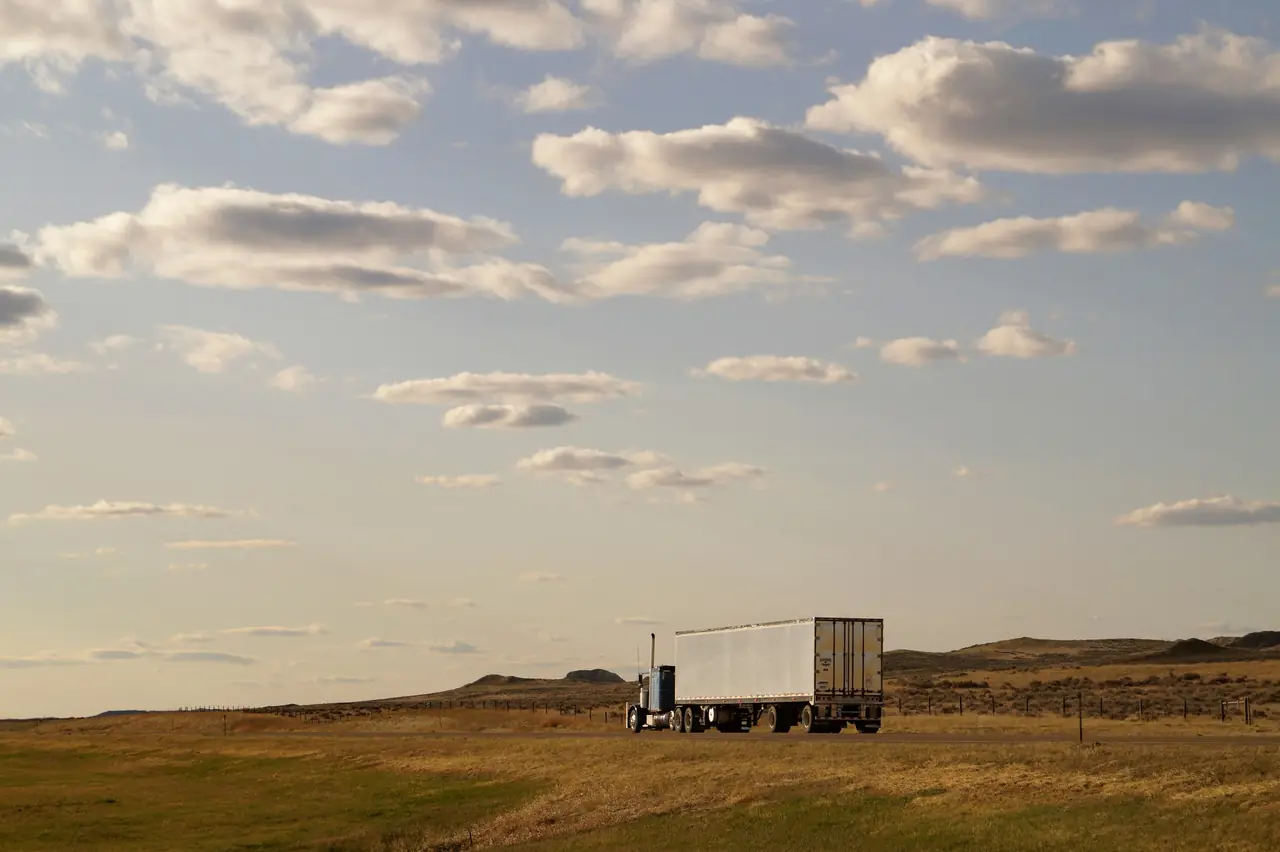
What farm freight looks like on the road
Agricultural freight splits into two very different kinds of load. The first is fresh produce: cartons of romaine and iceberg lettuce from the Salinas Valley, strawberries from Watsonville, potatoes from eastern Idaho, apples from Wenatchee, Washington, onions from the Treasure Valley. It is perishable from the moment it is cut, it is loaded at packing sheds and cold storage facilities, and it rides in refrigerated trailers to grocery warehouses, terminal markets and food service distributors across the country. The second is everything that supports the farm: tractors, balers, sprayers and combine headers on open deck, plus palletized seed, bagged fertilizer, animal feed and irrigation parts in vans or on flatbeds. The produce side runs on hours and temperature. The equipment side runs on dimensions and securement. Both are seasonal, and both lose trucks to each other and to every other industry when harvest peaks. A shipper who understands both sides plans better on each.
Matching trailers to farm freight
The commodity and its dimensions pick the trailer. These are the common matches.
| Freight | Trailer | Key point |
|---|---|---|
| Lettuce, berries, citrus, apples | 53 ft reefer | Pre-cooled to the shipper's set point |
| Time sensitive produce, long lanes | Reefer with team drivers | Roughly twice the daily miles of a solo |
| Tractors, balers, sprayers | Step deck | Lower deck typically takes freight about 10 ft tall |
| Irrigation pipe, hay, fencing, bins | Flatbed | Freight about 8 ft 6 in tall on a 5 ft deck |
| Seed, fertilizer, feed in bags | Dry van or tarped flatbed | Weight runs out before floor space |
Typical figures: a 53 ft reefer runs about -20 F to 70 F and carries 42,000 to 44,000 lb. A step deck carries up to about 46,000 lb, a flatbed up to about 48,000 lb. Exact numbers depend on the carrier and trailer. The trailer guide compares dimensions in more detail.
Seasonality from Salinas to Yuma
Produce capacity follows the harvest, and the harvest moves across the map. Leafy greens show it best. The Salinas Valley is the country's best known lettuce region, and the Salinas and Watsonville shipping point appears in the USDA AMS Specialty Crops Market News (opens in a new tab) movement reports that buyers and carriers watch. Through the warm months, lettuce, spinach and spring mix ship out of Salinas. As winter comes, production shifts south to the desert region around Yuma, Arizona and the Imperial Valley in California, then returns to Salinas in spring. Trucks follow it. Reefer drivers who spent the summer loading in Salinas reposition to Yuma, and pickup points, transit times and lanes change with them: a Salinas to Chicago load in summer becomes a Yuma to Chicago load in winter. Other crops have their own seasons, such as Georgia peaches, Michigan apples and Florida citrus. When several regions peak at once, reefers get scarce everywhere and booking ahead matters most.
Pre-cooling produce before loading
Pre-cooling means two things on a produce load, and both have to happen. The first is removing field heat from the product. Lettuce picked on a warm afternoon carries that warmth into the carton, and a reefer is designed to hold temperature, not to pull a full trailer of warm product down quickly. That is why packers cool produce at the shed before it ships. Iceberg lettuce is commonly vacuum cooled. Strawberries and other berries are usually forced air cooled. Sweet corn and broccoli are often hydrocooled or packed with ice. The second meaning is pre-cooling the trailer itself to the shipper's set point before loading, so cold product does not go into a warm box. The FDA sanitary transportation rule (opens in a new tab) requires the loader to confirm the refrigerated compartment is pre-cooled before loading, and that duty can be passed to the carrier in writing. Load warm product and the trailer can only slow the damage.
Set points come from the shipper
The shipper states the reefer temperature, and the carrier runs to it. That is how the FDA rule is built: for food that needs temperature control for safety, the shipper gives the carrier the operating temperature in writing, including pre-cooling. Different produce needs different ranges, so there is no single produce setting. Leafy greens and berries want cold. Some tropical and warm season crops, such as bananas, tomatoes and some squash, suffer chilling injury if held too cold, so a set point that suits lettuce would damage them. The set point belongs on the rate confirmation with the mode. Continuous mode keeps air moving across the load all the time, which most fresh produce needs to keep temperature even from nose to doors. Cycle mode saves fuel but lets temperature swing between cycles. If the receiver checks pulp temperature, the probe reading inside the product, give the acceptable range too, so the driver can check it at loading and note it on the bill of lading.
Mixed temperature produce loads
Mixed loads save money but carry real risk if the items do not belong together. A mixed produce load combines two or more commodities on one reefer, often for a single grocery buyer, such as onions, potatoes and citrus going from a western consolidator to a warehouse in Texas. Three things decide whether items can share a trailer. Temperature: every item must tolerate the same set point, or the load needs a divided trailer with two temperature zones. Humidity: leafy greens want moisture that would harm onions. Ethylene: apples, pears and some melons give off ethylene gas, and sensitive items such as lettuce, broccoli and cucumbers can spot, yellow or soften when they ride beside them. List every item, its pallet count and its temperature need when you request the load. A consolidator who knows the mix can plan the order of stops and the position of each pallet, so the first delivery comes off the doors first and the cold air reaches what needs it most.
Waiting at the shed
Produce sheds and coolers load when the product is ready, and that is not always when the appointment says. In peak harvest a packing shed may be packing orders for many buyers at once, and a truck can sit while the shed finishes the order, waits for a field to come in, or runs the product through cooling. That wait has a cost the shipper does not always see. Under the FMCSA hours of service rules (opens in a new tab), a driver cannot drive past the 14th hour after coming on duty, and waiting at the shed counts toward that window. A driver who sits through the afternoon may leave with only a few driving hours left, which pushes the delivery back. Drivers who know produce expect some waiting and plan their breaks around it. The shipper can help by giving a realistic load time, calling ahead when an order slips, and stating when detention starts, so nobody argues about it later.
The FSMA rule on a produce load
Fresh produce that needs temperature control falls inside the FDA rule, and each party on the load has a job. The FDA's summary of the rule (opens in a new tab) sets them out.
| Role | On a produce load |
|---|---|
| Shipper (often the grower or packer) | Gives the carrier the operating temperature and pre-cooling instructions in writing |
| Loader (the shed or cooler) | Confirms the trailer is pre-cooled before loading, or delegates that check to the carrier in writing |
| Carrier | Pre-cools as specified and, on request, shows temperature was maintained by an agreed method |
| Receiver | Checks for significant temperature abuse on arrival |
Written agreements are kept 12 months after they end. The agreed method for proving temperature is usually ambient readings at load and unload or a download of time and temperature data from the reefer unit.
How produce loads go wrong
Most produce claims start with temperature, and most temperature problems start at the shed. A load of strawberries arrives with warm pulp because it was loaded before cooling finished. A load of romaine shows freeze damage at the nose because the set point was entered wrong or the unit ran in the wrong mode. A trailer of lettuce shows russet spotting because it rode beside apples. Pallets lean or crush because cartons were stacked weak side down and shifted on the road. Then there is time. A load that sat at the shed half a day misses its delivery slot at the warehouse, and the receiver either turns it away or accepts it with a reduced shelf life that the buyer will remember. When a receiver refuses produce, the product is already far from home and losing value hourly, so the shipper has to find a new buyer fast. Clear records at loading, including the set point, the pulp readings and photos of the load, make that conversation shorter.
How to prevent produce claims
Claims are cheaper to prevent than to argue. These steps cover the usual causes.
- Cool the product fully at the shed before loading.
- Pre-cool the trailer to the set point and record the reading.
- Put the set point, mode and pulp range on the rate confirmation.
- Probe pulp temperature at loading and write it on the bill of lading.
- Photograph the load and the reefer display before the doors close.
- Keep incompatible items apart, or use a divided trailer.
- Load with airflow space at the nose and the rear doors.
- Give the receiver's appointment to the driver in writing.
The two steps most often skipped are the pulp reading and the photos. Without them, a dispute about whether product was warm at loading or warmed on the road has no evidence on either side. A minute with a probe thermometer and a phone camera is the cheapest insurance a shipper can buy.
Salinas to Chicago transit time
Long produce lanes are where transit time decides the equipment. Salinas to Chicago runs about 2,200 road miles, north on US 101 and east on I-80, as the Salinas to Chicago reefer lane guide covers in detail. Our planning rule of thumb is about 550 miles a day for one solo driver, based on the federal limits of 11 hours of driving after 10 hours off. The math: 2,200 / 550 = 4 days for a solo driver. A team keeps the truck moving while one driver sleeps and covers about 1,000 miles a day, so the same run takes about 2 to 3 days. For lettuce and berries, a day or two less on the road means more shelf life at the store, which is why produce buyers often pay for teams on cross country lanes. In winter, the same logic applies from Yuma, where the run east follows the southern interstates instead. Waiting at the shed eats into both estimates.
Ag equipment on open deck
Farm machinery moves on open deck, and its dimensions set the trailer before its weight does. A compact tractor or round baler fits a flatbed, where freight typically stays under about 8 ft 6 in tall on a deck about 5 ft off the road. A taller mid-size tractor or sprayer goes on a step deck, whose lower deck typically takes freight about 10 ft tall. Width matters too. The federal width limit on the National Network is 102 inches (opens in a new tab), so a machine with wide duals or a wide header must be broken down or moved under permit. The federal government issues no oversize permits (opens in a new tab). Each state on the route does. Securement follows 49 CFR 393.130 (opens in a new tab) for heavy vehicles, equipment and machinery: accessories lowered and secured, articulated parts locked, and the machine restrained against movement in every direction. Send exact dimensions and weight, including any attachments that stay on.
Bagged and palletized farm inputs
Seed, fertilizer, feed and crop protection products move in bulk bags, palletized bags or boxed cases, and they are heavy for their size. A pallet of bagged feed or fertilizer weighs far more than a pallet of boxed goods the same size, so a 53 ft dry van or flatbed usually reaches its weight limit long before its floor is full. Typical payload is 42,000 to 45,000 lb for a dry van and up to about 48,000 lb for a flatbed. Input freight is seasonal in its own way. Seed and fertilizer move ahead of planting, from retailers and distribution yards in towns across the Corn Belt, which puts them in competition with every other spring shipper for the same trucks. Moisture is the main risk. Fertilizer and feed can cake or spoil if wet, so flatbed loads need tarps and vans need dry, intact floors and roofs. Some crop protection products are regulated as hazardous materials, so tell the broker the product name and its safety data before quoting.
What to send for a produce or ag quote
A complete request gets a firm price and the right truck on the first try.
- Pickup shed or cooler and delivery facility, with city, state and ZIP
- Pickup date and realistic load time, plus the delivery appointment
- Commodity, pack (cartons, bins, bags) and pallet count
- Set point in degrees Fahrenheit, mode, and pulp temperature range
- Every item on a mixed load, with its temperature need
- Total weight and whether pallets stack
- For equipment: length, width, height, weight and how it loads (driven, craned or forklifted)
- Any attachments, tarping or hazmat details
- Whether the load needs a team to meet the buyer's date
The set point and the realistic load time are the two items most often missing. Without them, a carrier either guesses the temperature or plans the day around a load time that will not happen.
How Powerhaul handles produce and ag
We cover both sides of farm freight: produce in pre-cooled reefers and ag equipment and inputs on open deck. On reefer loads the set point is confirmed before the wheels turn, and we book drivers who will wait at the shed rather than leave when the order runs late. Shed and cooler pickups, mixed temperature loads and seasonal capacity are part of the plan from the first call, and when a buyer's date is tight we can put team drivers on the load. For tractors and machinery we book step decks and flatbeds sized to the dimensions you send. Every carrier is checked against FMCSA records before it hauls, and one person stays on every load from booking to delivery, so you have one name to call when a field runs late. Your rate comes from a person, not a formula. Send the lane, freight and date through the quote form and we will come back with a price and a truck.