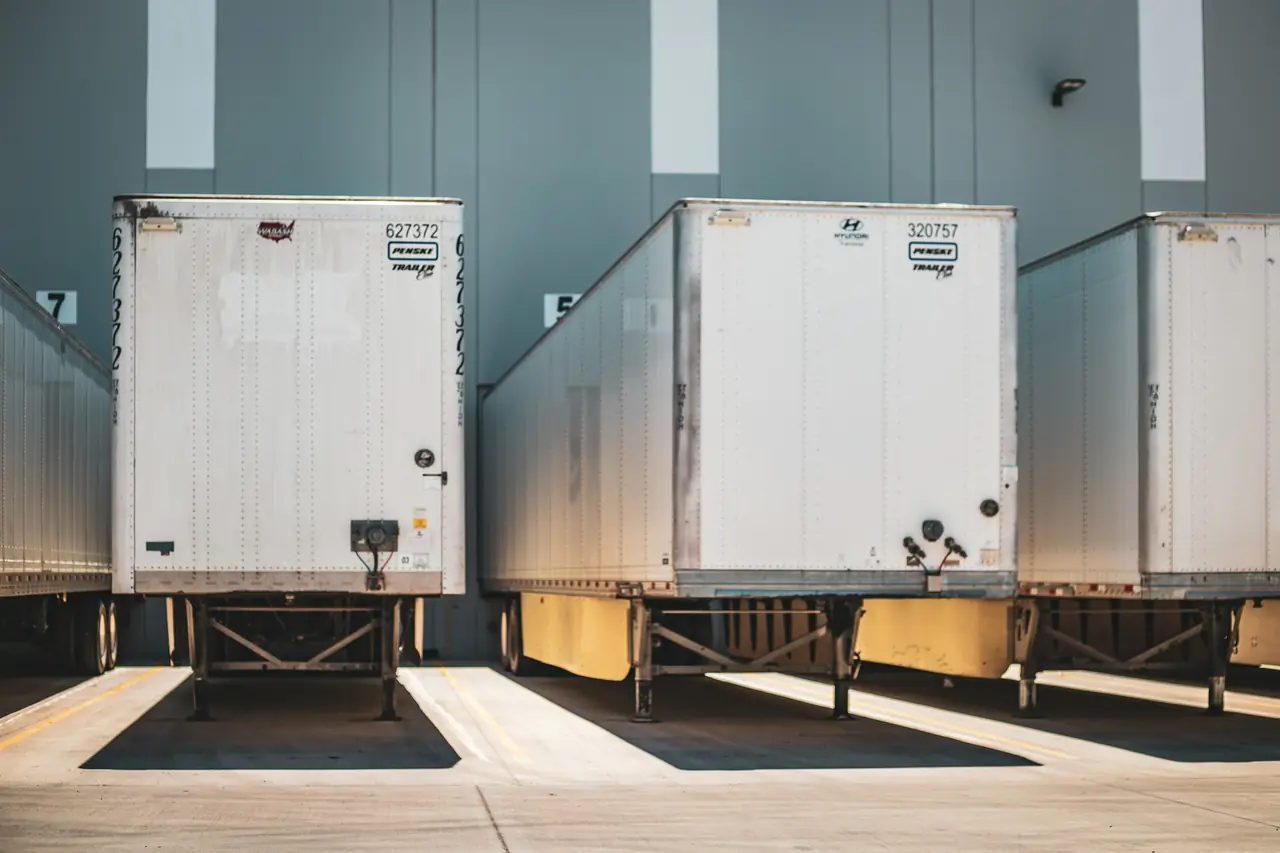
What power only trucking is
Power only trucking is a load where the carrier supplies a tractor and a driver and nothing else. The trailer is yours: owned, leased or rented. The driver arrives with a bare tractor, hooks your trailer, pulls it where it needs to go, and drops it.
That flips the usual truckload arrangement. On a standard full truckload, the carrier brings its own trailer, you load it, and it leaves with the carrier's equipment. With power only, the trailer stays in your control. You decide when it gets loaded, where it waits, and where it goes next.
Power only is built for shippers who already have trailers sitting in a yard and loads that need to move. Typical users are manufacturers and distributors with their own trailer fleets, retailers running trailer pools between distribution centers and stores, and companies that lease or rent trailers to handle a seasonal peak. It also suits anyone who needs empty trailers moved to where they will be loaded next.
Power only compared with other options
Choose power only when you have the trailer and need the truck. Choose a carrier-supplied trailer when you do not own equipment, or when your trailers are all busy. The table compares the common setups.
| Option | Whose trailer | Loading | Best for |
|---|---|---|---|
| Power only | Yours (owned, leased or rented) | Preloaded before the driver arrives | Shippers with trailer fleets or pools |
| Full truckload, live load | Carrier's | Driver waits while you load | One-off loads, no trailers of your own |
| Drop trailer | Carrier's, left at your dock | You load on your schedule | Repeat freight without owning trailers |
| Dedicated lanes | Usually carrier's | Committed schedule | High, steady volume on fixed lanes |
The real comparison is between power only and drop trailer service. Both let you load without a driver waiting. In drop trailer service the carrier owns the trailer and has to keep spare trailers near you; with power only, you own the trailer and the carrier only has to supply a tractor. If you already pay for trailers, power only makes them work harder. If you do not, a drop program avoids the cost of owning them. Many shippers run both: their own trailers on core lanes and carrier trailers for overflow.
Who uses power only
Power only fits any operation where trailers and tractors do not belong to the same company. The common cases:
- Shippers with private fleets. A company with its own trailers but not enough drivers to move all of them uses power only to cover the gap, especially in busy weeks.
- Retail and distribution networks. Trailers move between distribution centers, stores and return centers in a loop. Power only carriers pull the loaded trailers out and bring empties back. See retail and consumer goods for how store freight runs.
- Manufacturers. Plants preload trailers at the end of a shift and need them gone before the next one. Our manufacturing page covers plant-to-plant freight.
- Seasonal surges. Shippers rent or lease extra trailers for peak season and need power to move them.
- Leasing and rental companies. Trailers need delivering to customers and bringing back.
Food and beverage shippers with their own reefer or van fleets use it the same way; the food and beverage page covers their extra sanitation and temperature rules.
What the carrier brings and what you bring
Power only divides the equipment cleanly, and both sides need to know which parts are theirs. The typical split:
| Item | Who supplies it |
|---|---|
| Tractor and fuel for the tractor | Carrier |
| Driver | Carrier |
| Trailer (van, reefer or flatbed) | You, a lessor or a rental company |
| Trailer insurance while it is in the carrier's possession | Carrier, confirmed before booking |
| Freight loaded and sealed | You or your loader |
| Reefer unit fuel and set point | Agreed in writing before pickup |
The details that cause trouble live in the gaps. Who fixes a flat tire on your trailer at mile 300? Who pays if the trailer is returned damaged? Who fuels the reefer unit? These questions are answered in the interchange terms, which is why they go on the rate confirmation instead of being settled at the roadside.
The tractor also matters. A day cab suits short yard moves and local shuttles; a sleeper tractor is needed for long runs. Say how far the trailer is going so the right tractor shows up, and whether the trailer needs a particular hitch height or air and electrical connection.
Drop and hook with power only
Drop and hook means the driver drops one trailer and hooks another, instead of waiting at a dock while freight is loaded or unloaded. Power only is the most common way to run it. The driver arrives with your empty trailer (or no trailer), drops it, hooks a preloaded trailer, and leaves.
That speed is the benefit for both sides. Your dock loads trailers when it suits your shift, not when a truck happens to arrive. The driver avoids sitting at the dock, which protects the 14-hour driving window (opens in a new tab) and makes your freight more attractive to carriers.
To work, a drop and hook program needs enough trailers to keep one loading while another is on the road, a yard where trailers can be staged, and clear rules on which trailer is ready. A trailer marked ready but not sealed costs the driver the time the program was meant to save. Our glossary explains drop and hook in a single line.
Trailer pools and repositioning empties
A trailer pool is a set of trailers that sit at your facilities so there is always one ready to load. Pools work only if the trailers are where the freight is. When freight flows mostly one way, from a plant to a distribution center for example, the trailers pile up at the destination and the origin runs short.
Power only fixes that imbalance. Carriers pull empties back to where they will be loaded, as empty moves or as the return half of a loaded run. Moving empties costs money; running out of trailers costs more.
The same service covers yard to yard moves, such as shuttling trailers from an overflow lot to a main yard, and repositioning for the season, such as moving trailers toward a region before its peak. Rental and leased trailers fit here too, collected from the lessor and returned at the end of the term.
When repositioning repeats on a fixed pattern, it can be priced as a dedicated lane rather than load by load.
Interchange and trailer insurance
Interchange is the handoff of a trailer from its owner to the carrier, and the terms that govern what happens while the carrier has it. On a power only load the interchange is handled on the rate confirmation, so the driver and the owner both know the rules before the trailer moves.
The terms usually cover the trailer's condition at pickup and return, who pays for damage while the carrier has it, who handles tires and roadside repairs, and how long the carrier can keep it.
Insurance is the other half. A carrier's normal auto policy covers the tractor; a trailer it does not own needs its own coverage, often called non-owned trailer or trailer interchange coverage. That coverage gets confirmed before the truck is booked. If the carrier cannot show it, the load does not move.
For pickup, the driver should note any existing damage on the interchange paperwork, ideally with photos, so condition disputes have evidence. Our glossary entry on interchange gives the short version.
Legal limits on your trailer
Your trailer, the carrier's tractor and your freight together must meet the same federal limits as any truck. The federal gross limit is 80,000 lb (opens in a new tab) for the combination. A single axle may carry 20,000 lb and a tandem 34,000 lb, and the bridge formula in the same regulation can require a lower gross depending on axle count and spacing.
On a power only load the driver did not see how the weight was placed. If the trailer is heavy in the nose or tail, the driver may need to slide the trailer tandem or ask for the load to be reworked. Send the weight with the load.
Size rules are the same too. Width is capped at 102 inches (opens in a new tab) on the National Network, states set height limits that FHWA reports range from 13.6 to 14.6 feet, and states may not limit a semitrailer to less than 48 ft.
The driver also inspects your trailer before pulling it, and a trailer with a defect waits until it is repaired.
Reefers and flatbeds under power only
Power only is not limited to dry vans. A carrier can pull your reefer or your flatbed, but each adds its own rules.
For a refrigerated trailer, the set point, mode and unit fuel level need to be in writing before pickup. If the load is food that needs temperature control for safety, the FDA's sanitary transportation rule (opens in a new tab) applies: the shipper gives the carrier written temperature requirements, and the carrier must maintain them and, on request, show that it did. The driver should check the unit is running at the right set point before hooking.
For a preloaded flatbed, securement is the issue. The driver is responsible for securement on the road, even when someone else chained the load. The system must meet the 393.102 (opens in a new tab) performance criteria, holding 0.8 g forward on breaking strength, so a driver who finds the chains or straps short of that will add or rework them before leaving. Tell us if a flatbed is preloaded so the driver comes with enough gear.
Hours of service and yard time
Power only drivers run under the same FMCSA hours of service rules as any property-carrying driver: 11 hours of driving after 10 consecutive hours off, no driving past the 14th hour after coming on duty, and a 30-minute break after 8 hours of driving. The 14-hour window keeps running while the driver waits, so time spent at your gate counts against the day.
That is why trailer readiness matters so much. A preloaded trailer that is sealed, with paperwork ready and its location confirmed, lets the driver hook and go. A trailer still being loaded, or one nobody can find, turns a quick move into detention.
For distance planning we use about 550 road miles a day for one solo driver and about 1,000 for a team, a rule of thumb rather than a law. A yard move takes minutes; a repositioning run of several hundred miles is a full day for one driver. The lane finder gives miles and transit time between freight cities.
What drives a power only rate
Power only rates are set by the same market as other truckloads, with a few differences that come from not supplying a trailer. The main factors:
- Lane balance. A tractor going into a market with little outbound freight may run back without a load, and the rate carries those miles.
- Distance. Longer runs cost more in total. Very short yard moves carry a minimum because the driver's time is committed either way.
- Equipment availability. Tractors that can take power only work are easier to find in some markets than others, and rates follow.
- Seasonality. Retail peaks and harvest seasons pull tractors toward the busiest freight.
- Trailer readiness. A trailer that is ready on arrival keeps the cost down; one that is not brings detention.
- Trailer type. Reefers need a driver comfortable with the unit; flatbeds may need securement gear.
- Accessorials. Detention, layovers, extra stops and a TONU if the trailer is not there all add.
A trailer that is ready, where we were told it would be, is the single biggest lever you control.
What to send for a power only quote
Power only quotes turn on the trailer, so start with the trailer details. Send:
- Trailer number, type (van, reefer or flatbed) and length.
- Where it sits: yard address, gate hours and any check-in rules.
- Who owns the trailer, and the owner's interchange and insurance requirements.
- Whether it is loaded or empty, and the weight if loaded.
- Delivery address, appointment or drop window, and where to leave the trailer.
- Seal number, if sealed.
- For reefers: set point, mode and unit fuel level.
- For flatbeds: whether the load is preloaded and secured.
- Whether the driver drops another trailer at pickup (drop and hook).
- How often the move repeats.
If you run a trailer pool, send the yards and the usual pattern of moves, and we can price the program. A quote costs nothing and there is no obligation to book.
How Powerhaul handles power only
Power only puts a tractor and driver on your equipment. It is built for drop and hook programs, trailer pools and moving empties to where they are needed. We bring the truck and the driver for your trailer.
We need the trailer number, type, and where it sits. Insurance for non-owned trailers gets confirmed before the truck is booked, and the interchange is handled on the rate confirmation. We handle preloaded trailer pickup, trailer repositioning, drop and hook programs, seasonal surge, rental and leased trailers, and yard to yard moves, across vans, reefers and flats.
You get one contact, the person who books the move and answers when it changes. Every carrier is verified against FMCSA records, insured and approved by our compliance team before it sees a load. Pricing is all in, with accessorials spelled out up front, and the signed proof of delivery and invoice arrive together once the move delivers.
Common power only problems and fixes
Power only goes wrong in the yard far more often than on the road. The usual ones:
- The trailer is not where it should be. Give the slot or door number and confirm it the day of pickup.
- The trailer is not ready. Not loaded, not sealed, or missing paperwork. Mark a trailer ready only when it is.
- The trailer has a defect. A flat tire stops the move. Check trailers before booking.
- The insurance does not match. The trailer owner requires coverage the carrier does not carry. Confirm before booking.
- The wrong truck shows up. FMCSA's fraud guidance (opens in a new tab) tells shippers to confirm the truck at pickup matches the contracted carrier. Check the name on the door before releasing your trailer.
- The reefer is not running. Unit off or low on fuel. Check the set point and fuel before hooking.
- Damage disputes at return. Note condition at pickup with photos on the interchange paperwork.
A ready trailer in a known spot, with the paperwork matched, makes power only one of the fastest moves in trucking.