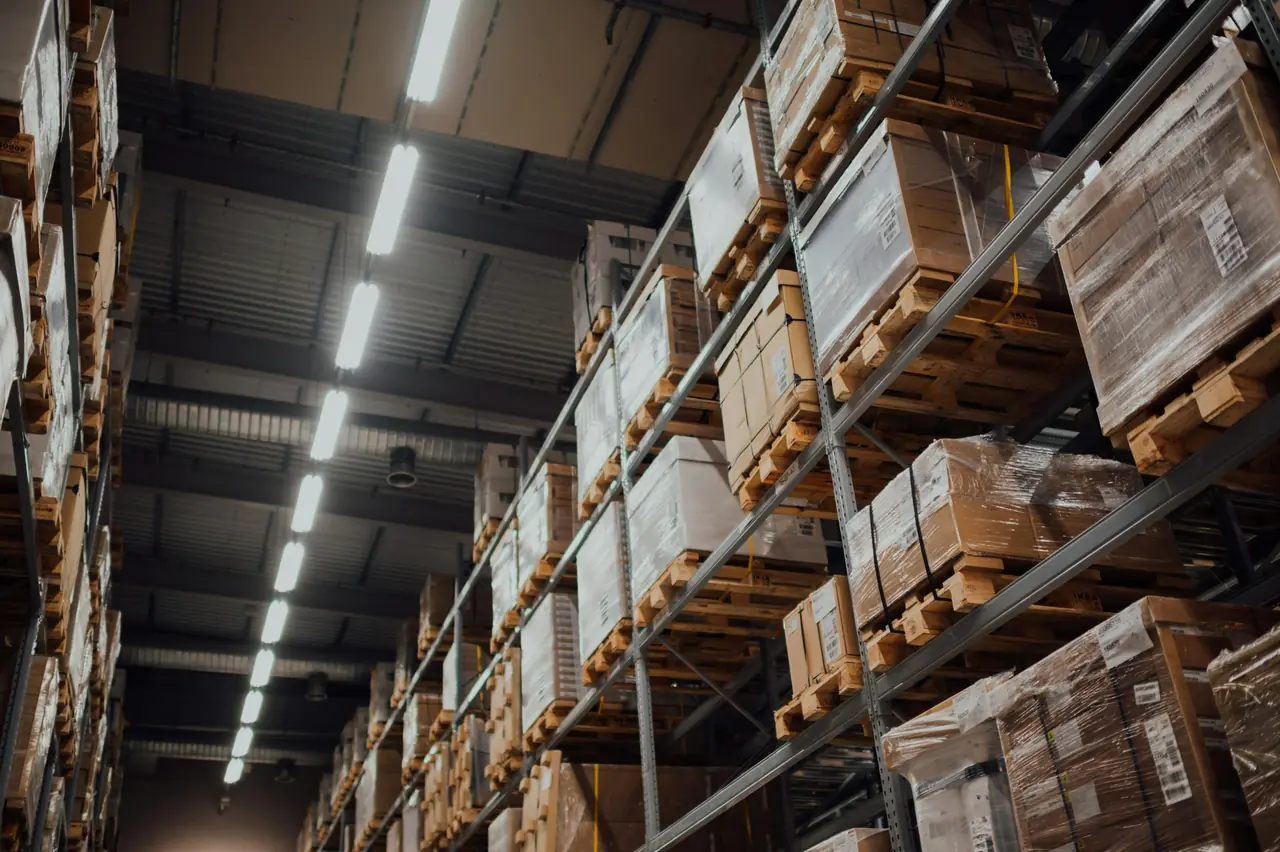
What retail freight looks like on the road
Retail freight is mostly finished consumer goods in cartons, moving in 53 ft dry vans toward a retailer's distribution center. Think flat pack furniture from a warehouse in Ontario, California, small kitchen appliances from an importer's yard near Savannah, paper towels from a converting plant in Wisconsin, or cartons of apparel from a fulfillment center near Columbus, Ohio. The loads are dry, rarely temperature sensitive, and usually lighter per cubic foot than food or building products, so many of them fill the trailer before they reach its weight limit. What makes retail freight different is the receiver. Large retailers run their inbound networks to a schedule and to written rules, and the vendor who ships the goods is held to those rules. A load that arrives late, labeled wrong or stacked outside the standard can cost the vendor money after it is delivered. The freight itself is simple to haul. The rules around it are where the work is.
Matching trailers to retail freight
Most retail freight rides in a dry van, but the program around the van changes with the volume and the receiver.
| Shipment | Best fit | Why |
|---|---|---|
| A full trailer to one DC | Full truckload dry van | One pickup, one delivery, priced by the truck |
| A mid-size order on a long lane | Partial | Pay for the space you use, without LTL terminal handling |
| Steady daily outbound from one warehouse | Drop trailer | Load on your schedule, carrier swaps trailers |
| Your own or a leased trailer pool | Power only | Tractor and driver for your trailer |
| Several stores on one route | Multi stop dry van | One trailer, stops loaded in reverse order |
Typical figures for a 53 ft dry van are about 52 ft 6 in by 8 ft 2 in by 9 ft inside, and 42,000 to 45,000 lb of payload. Exact numbers depend on the carrier.
Delivery windows and routing guides
A retail delivery window is a booked appointment at the receiving DC, and the routing guide says how to get one and what happens if you miss it. Each major retailer publishes its own guide as part of the vendor agreement. It sets how loads are tendered, how far ahead appointments must be booked, which documents travel with the load, how cartons are labeled, and how pallets must be built. The appointment is usually tied to a purchase order number, and the DC builds its labor plan around the slots it gives out. A truck that arrives early may wait at the gate. A truck that arrives late may be refused and rescheduled, and the vendor may be charged for the miss. Some DCs accept certain freight first come, first served, but most full truckloads into large chains move by appointment. The practical rule: get the appointment confirmation number before the truck is dispatched, and give it to the driver in writing.
Chargebacks and vendor compliance
A chargeback is a deduction the retailer takes from your invoice when a shipment breaks its rules. The most common triggers are timing (late or early arrival, missed appointment, no show), labeling (missing or unreadable carton or pallet labels), pallet build (overhang, wrong height, mixed products on one pallet when the guide forbids it), and paperwork (missing advance ship notice, purchase order mismatch). The amounts and the grace periods differ by retailer and are set in the vendor agreement, so there is no single figure to plan around. What is the same everywhere is that the deduction usually arrives weeks after delivery, long after anyone remembers what happened at the dock. The only defense is evidence: the appointment confirmation, the check in time, the signed delivery receipt and photos of the load. Treat compliance as part of the freight cost. A cheap truck that misses the window often costs more than the difference in rate.
Floor loaded or palletized
Floor loading stacks cartons directly on the trailer floor. Palletized freight rides on pallets moved by forklift. Each has a place.
| Factor | Floor loaded | Palletized |
|---|---|---|
| Cartons per trailer | More, no pallet space lost | Fewer, pallet height and gaps lost |
| Load and unload time | Hours by hand | Short with a forklift |
| Unloading fee at the DC | Usually higher | Usually lower |
| Damage risk | Crushing in tall stacks | Shifting if not wrapped and braced |
| Typical use | Light imported goods from containers | Domestic replenishment to DCs |
Floor loading is common on imports transloaded from ocean containers, where every cubic foot counts. Palletized loads suit most domestic DC deliveries, and many routing guides require them. Ask for driver unload or a lumper arrangement in writing either way.
Pallet math for retail loads
Retail loads often cube out, meaning they fill the trailer before they reach its weight limit, so pallet count is the planning number. A 53 ft trailer is 636 inches long. Standard 48 x 40 in pallets (opens in a new tab) loaded with the 48 in side along the trailer give 636 / 48 = 13 rows, times 2 across, for 26 pallets. Turned, with the 40 in side along the trailer, 636 / 40 = 15 rows, times 2, for 30 pallets. Height matters as much as footprint. With about 9 ft of inside height typical in a dry van, light cartons can stack two pallets high if they are built to carry the weight, which can double the count of pallet positions used. Heavy goods such as canned household products or bagged pet food go the other way. They reach the typical 42,000 to 45,000 lb payload first, inside the federal 80,000 lb (opens in a new tab) gross limit. Run the numbers in the pallet planner.
Multi stop store runs
A multi stop load puts deliveries for several stores or DCs on one trailer, loaded so the first stop comes off the doors first. It suits a regional chain sending a mix of goods to five stores across Georgia and the Carolinas, or a vendor delivering to two DCs on the same corridor, such as Chicago to Indianapolis and then on to Louisville. The planning work is in the sequence. Freight for the last stop loads at the nose of the trailer, the first stop's freight sits at the doors, and each stop's pallets are labeled so the driver and receiver can tell them apart. Each stop has its own appointment, and a delay at the first one ripples through the rest, because the driver's hours keep counting. Under the FMCSA rules (opens in a new tab), a driver cannot drive past the 14th hour after coming on duty, and unloading time counts. Fewer stops with realistic appointment spacing beats an ambitious route that collapses at stop two.
Drop trailer programs
A drop trailer program parks empty trailers at your dock so your team loads them on your schedule, and the carrier picks up the loaded trailer and leaves an empty. It fits a warehouse that ships steady volume every day, such as a consumer goods distributor in Dallas sending loads to several retail DCs each week. The benefit is control. Your dock crew loads during the shift instead of racing a live truck, the driver does not wait, and there is no detention on loading. Receivers like it too: many large DCs accept drop and hook deliveries, where the driver leaves the loaded trailer and the DC unloads it when a door opens. The trade off is commitment. A carrier only parks trailers at your dock if the volume justifies it, so drop programs suit regular lanes rather than occasional loads. Yard space, trailer inspections and a clear record of which trailer is loaded and which is empty keep the program running.
Partials and volume LTL
Not every retail order fills a truck, and the right option depends on size and fragility. For a handful of pallets, LTL is usually the economical choice. LTL is priced by freight class, and since July 2025 the NMFC (opens in a new tab) has moved many commodities to classification based mainly on density, so light, bulky retail goods often class higher than they used to. Full truckload is priced by the truck, not by class. Between the two sits the partial, sometimes called volume LTL: a share of a dry van, usually for mid-size orders, moved without the terminal cross docking that LTL uses. Fewer touches mean less damage risk for retail cartons that crush or scuff. A partial from Chicago to Atlanta, for example, can ride with another shipper's freight on the same lane and arrive in about the same time as a full truckload. The freight class calculator helps when you compare against LTL quotes.
Peak season in retail freight
Retail freight has a strong calendar, and trucks get scarce ahead of the big selling seasons rather than during them. Back to school goods move inland through the summer. Holiday goods start arriving at the West Coast and East Coast ports well before autumn, then move to inland warehouses and on to retail DCs through the autumn. That wave competes with produce, food and every other shipper for the same dry vans and drivers, so spot capacity tightens and appointments at busy DCs book further out. After the holidays, return freight and clearance moves follow. The way to handle peak is to plan it. Share your forecast with your carrier or broker before peak begins, lock in regular lanes where volume is predictable, keep drop trailers on the dock if your outbound justifies it, and book DC appointments as early as the routing guide allows. Shippers who tender at the last minute in peak pay for it in rate and in missed windows.
How retail loads go wrong
Retail loads usually fail on compliance and timing, not on the road. A truck dispatched without an appointment arrives to find no door available for two days. A load built with pallets taller than the routing guide allows is refused or reworked at the DC, with a charge to the vendor. Cartons stacked too high in a floor loaded trailer crush the bottom layers, and the receiver notes damage on the delivery receipt. Labels are missing on one side of the pallet, so the DC cannot scan it. The driver gets held at the shipper for hours while the order is finished, misses the delivery slot, and the reschedule pushes the load past the purchase order's cancel date. Paperwork does not match: the bill of lading says 24 pallets, the receiver counts 23, and a shortage claim follows. Most of these problems are visible before the trailer doors close, which is where they are cheapest to fix.
How to keep a retail load clean
These checks cover the usual causes of chargebacks, refusals and short claims.
- Read the current routing guide for each retailer you ship to.
- Book the delivery appointment before dispatch and record the confirmation number.
- Build pallets to the guide's height, overhang and labeling rules.
- Count pallets and cartons at loading and match them to the bill of lading.
- Photograph the load at the doors and record the seal number.
- Give the carrier a realistic pickup time, not a hopeful one.
- Get the signed POD with any exceptions noted, and keep it with the invoice.
The step most often skipped is the photo and seal number. When a chargeback or shortage claim arrives weeks later, those two records show what left your dock, and they settle most disputes quickly.
Proof of delivery and a clean invoice
The proof of delivery, or POD, closes a retail load and protects the invoice. It is the receiver's signed copy of the bill of lading or delivery receipt, showing the date and time, the count received, and any exceptions for damage, shortage or overage. A clean POD, signed with no exceptions, is the strongest evidence that the load arrived complete and on time. A POD with exceptions starts a process: the vendor checks the count against the loading records, and either the shortage is real and a claim follows, or the count was wrong at the DC and the photos and seal record dispute it. Getting the POD back quickly matters because retail payment terms, chargeback deadlines and claim windows are all running. A POD that arrives weeks later leaves no time to dispute a deduction. Ask for it with the delivery notice, and file it with the purchase order and invoice.
What to send for a retail quote
A complete request gets a firm price and a carrier who knows the receiver's rules.
- Pickup and delivery addresses, with the DC or store number
- Pickup date and the delivery appointment, or who books it
- Retailer name, so the routing guide rules are known
- Floor loaded or palletized, pallet count, size and whether they stack
- Total weight and carton count
- Number of stops and the order they deliver in
- Unloading: driver unload, lumper, or drop and hook
- Repeat volume, if the lane ships weekly or daily
- Peak season forecast, if you expect volume to jump
Retailer name and appointment status are the two items most often left off, and they decide whether the load arrives compliant. If the routing guide names a pallet height or label standard, send that page too, so the carrier knows the rules before pickup.
How Powerhaul handles retail freight
We book to the appointment, track to the dock, and get the POD back fast so the invoice is clean. Retail DC compliance is part of the plan before the truck is dispatched, not something sorted out at the gate. We handle floor loaded and palletized freight, multi stop store runs, drop trailer programs, and partials and volume LTL for orders that do not fill a truck. When peak season tightens capacity, we plan it with you ahead of time. Every carrier is checked against FMCSA records before it hauls, and one person stays on every load from booking to delivery, so when a DC moves an appointment you have one name to call. Your rate comes from a person, not a formula. Send the lane, freight and date through the quote form, and we will come back with a price and a truck.