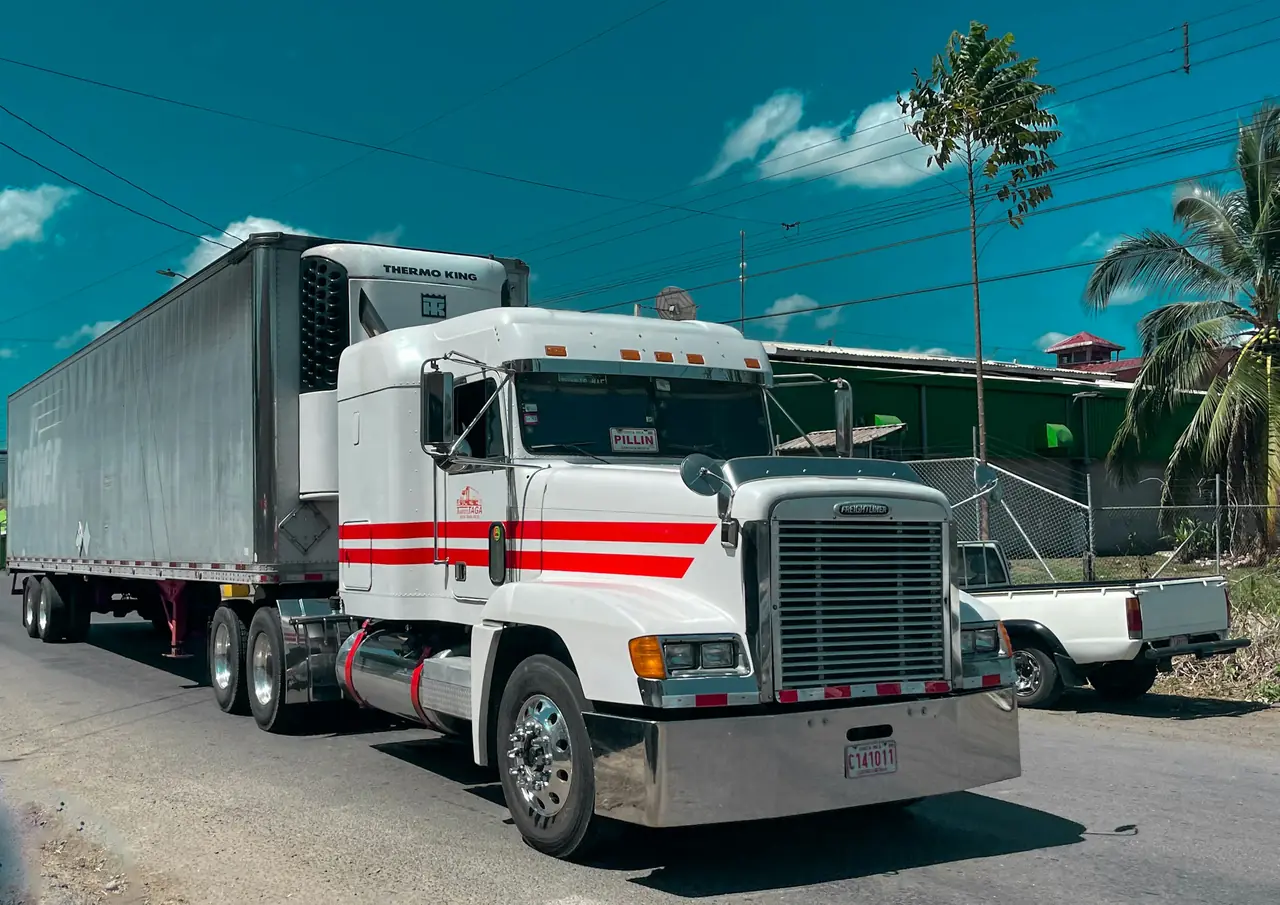
What reefer shipping is
Reefer shipping is truckload freight moved in a refrigerated trailer: an insulated box with a diesel-powered unit on the front wall that cools or heats the load to a set point and circulates air around it. "Reefer" is short for refrigerated, and the word covers both the trailer and the service.
The point of a reefer is not to make freight cold. It is to keep freight at the temperature it was loaded at, for the whole run, while the outside air swings from a Central Valley afternoon to a Rocky Mountain night. A reefer unit is built to hold temperature, not to pull a warm load down quickly, which is why what happens at the dock matters as much as what happens on the road.
Reefers serve anyone shipping food or other products that spoil, melt, freeze or degrade outside a temperature band: growers and packers, protein and dairy plants, frozen food makers, beverage shippers in winter, and distributors supplying grocery chains. Like a dry van, a reefer runs as a full truckload, dock to dock.
Reefer compared with other options
Pick a reefer when the product has a temperature requirement, or when the weather on the lane could damage it. Pick a dry van when the freight is stable at outside temperatures, because a dry van usually costs less and carries a little more. The table shows how the options line up.
| Option | Temperature control | Best for | Trade-off |
|---|---|---|---|
| Dry van | None | Shelf-stable goods in mild weather | No protection from heat or freezing |
| Reefer, continuous | Unit runs the whole trip | Produce, fresh protein, dairy | Uses more fuel |
| Reefer, cycle | Unit starts and stops around the set point | Frozen and less sensitive goods | Wider temperature swing |
| Reefer, protect from freeze | Unit heats to stay above freezing | Beverages, paint, chemicals in winter | Reefer rate for dry freight |
| Reefer partial | Shares a reefer at one set point | A few pallets of chilled freight | All freight must share the temperature |
The deciding question is what happens if the product sits at the worst temperature the lane will see. If the answer is a rejected load, book the reefer. A load of bottled drinks from Texas to Minnesota in January is a reefer load even though nothing about it needs to be cold. Retail shippers run into this every winter with paint, cleaning products and anything water-based; our retail and consumer goods page covers that freight. Our trailer guide compares dimensions and payload across every trailer type.
Reefer trailer specs and limits
A typical 53 ft refrigerated trailer is built heavier than a dry van because of insulated walls, a sealed floor with air channels, and the refrigeration unit itself. That extra weight comes out of the payload. The figures below are typical; exact numbers depend on the carrier and the trailer.
| Measure | Typical figure |
|---|---|
| Length | 53 ft |
| Temperature range | Roughly minus 20 F to 70 F |
| Floor | Up to 26 pallets, depending on the trailer |
| Payload | Usually 42,000 to 44,000 lb |
The legal limits are the same as any truck on the Interstate. The federal gross limit is 80,000 lb (opens in a new tab) including tractor, trailer, unit, fuel and freight, with 34,000 lb on a tandem axle and 20,000 lb on a single axle. Width is capped at 102 inches (opens in a new tab) on the National Network. Thick insulated walls take space from that width, so pallet counts that work in a dry van, such as 30 turned pallets, often do not fit in a reefer. Run your pallet sizes through the pallet planner before promising a count.
Continuous or cycle mode
Every reefer load needs two settings, not one: the set point and the mode. The set point is the temperature the unit holds. The mode is how it holds it.
In continuous mode the unit runs and the fan moves air through the load for the entire trip. The temperature band stays tight, and air keeps moving around the product, which matters for produce that gives off heat and moisture as it respires. Fresh fruit and vegetables, fresh meat and dairy usually ship continuous.
In cycle mode (often called start-stop) the unit shuts down once the box reaches set point and restarts when the temperature drifts. It saves fuel, but the air stops moving between cycles and the temperature swings wider. Frozen freight that is solid at loading usually tolerates cycle mode, and so does product with a forgiving temperature band.
Put both settings in writing. A set point with no mode leaves the choice to whoever turns the unit on, and cycle mode on a load of lettuce can get it rejected.
Pre-cooling and pulp temperatures
Two temperatures get checked at the dock: the trailer's and the product's. Pre-cooling means running the unit so the empty trailer is at set point when the doors open.
Pulp temperature is the internal temperature of the product itself, taken with a probe thermometer in a sample of cartons. It tells you whether the freight is at the temperature it should travel at. A reefer is designed to hold that temperature, not to bring hot product down, so a load that leaves the cooler too warm will likely arrive too warm.
A good practice at pickup:
- Confirm the trailer was pre-cooled to the set point on the rate confirmation.
- Check the unit display shows the right set point and mode.
- Probe a few cartons from different pallets and write the pulp temperatures on the bill of lading.
- Keep loading time short so warm dock air does not flood the box.
Pulp readings recorded at pickup are the strongest evidence you have if the receiver later disputes condition.
FSMA sanitary transport duties
If you ship human or animal food, the FDA's sanitary transportation rule (opens in a new tab) under the Food Safety Modernization Act assigns duties to every party in the chain: shippers, loaders, motor and rail carriers, and receivers. Each has a specific job.
| Party | Duty under the rule |
|---|---|
| Shipper | Gives the carrier written operating temperature, including pre-cooling, for food that needs temperature control for safety |
| Loader | Confirms the refrigerated compartment is ready (pre-cooled) before loading; can delegate this to the carrier by written agreement |
| Carrier | Pre-cools as specified and, on request, shows the temperature was maintained |
| Receiver | Checks for significant temperature abuse on arrival |
The method the carrier uses to show temperature was maintained is agreed in writing, according to FDA's summary of key changes (opens in a new tab). It can be ambient temperature readings at loading and unloading, or time-temperature data from the trip. Agree on which before the first load, not after a dispute. The rule puts the burden on paperwork, so a missing agreement is a compliance gap even when the freight arrives perfect. As a broker we pass your written temperature instructions to the carrier on the rate confirmation, which is why we ask for them in writing at quote time rather than by phone at the dock.
Written agreements and records
Under the sanitary transport rule, the arrangements between shipper, loader and carrier are written down, and those written agreements must be kept for 12 months after they end. That covers who pre-cools, what temperature applies, and how the carrier will demonstrate that temperature was held.
In practice the rate confirmation carries the load-level details: set point, mode, pre-cool requirement and any instruction about the temperature record. A master agreement or shipping instructions carry the standing terms. Keep both. If a receiver claims temperature abuse months later, the paper trail decides who pays.
There is one notable exemption. Food that is fully enclosed in a container is exempt from the rule unless it needs temperature control for safety. Canned goods in a dry van are generally outside it; packaged fresh chicken in a reefer is not. If you are unsure whether your product counts as needing temperature control for safety, treat it as covered and write the temperature down. It costs nothing and it settles the question if anything goes wrong.
Loading a reefer for airflow
A reefer cools by moving air, so the way pallets sit in the trailer decides whether every carton stays at temperature. Cold air leaves the unit near the ceiling, travels to the rear doors, then returns along the floor and through the load back to the unit. Anything that blocks that loop creates warm spots.
The basic rules:
- Do not stack product to the ceiling. Leave clear space at the top for air to travel the length of the trailer.
- Keep the return air path at the front wall clear. A pallet jammed against the unit bulkhead starves it.
- Use pallets and the trailer's floor channels so air can pass underneath.
- Do not wrap pallets so tightly that air cannot reach product that needs it, such as produce in vented cartons.
- Load fast and close the doors between pallets on hot days.
Mixed loads add a constraint: everything on the trailer shares one set point. You cannot ship frozen product and fresh produce together in a standard single-temperature reefer, even if the total fits on the floor.
Typical reefer freight
Reefers carry anything that has a temperature requirement, and in winter, plenty that simply cannot freeze. The common categories:
| Freight | Usual setting | Watch point |
|---|---|---|
| Fresh produce | Chilled, continuous | Pulp temperatures and airflow |
| Fresh meat and poultry | Chilled, continuous | Tight band, sanitation |
| Dairy | Chilled | Receiver appointment discipline |
| Frozen food | Frozen, often cycle | Product solid at loading |
| Beverages and chemicals in winter | Protect from freeze | Set point above freezing |
Produce is the most seasonal. Leafy greens from the Salinas Valley appear in USDA Market News (opens in a new tab) movement reports for the Salinas-Watsonville shipping point, and in winter much of that production moves south to the Yuma, AZ and Imperial Valley, CA desert region before returning to Salinas in spring. Trucks follow the crop, so reefer capacity in the desert tightens in winter and Salinas capacity tightens again in spring. Frozen and dairy freight is steadier through the year, but holiday baking and grilling seasons still move volume. Our produce and agriculture page covers grower and packer freight, and food and beverage covers processed and packaged food.
Planning reefer transit time
Long-haul reefer freight is often fresh food on a clock, so transit planning matters more than it does for dry goods. Drivers run under FMCSA hours of service (opens in a new tab): 11 hours of driving after 10 consecutive hours off, no driving past the 14th hour on duty, and a 30-minute break after 8 hours of driving. Time spent waiting for a produce shed to finish loading counts against that 14-hour window.
For planning we use about 550 road miles a day for a solo driver and about 1,000 for a team. On the classic produce lane, the math looks like this:
| Lane | Road miles | Solo (2,200 / 550) | Team (2,200 / 1,000) |
|---|---|---|---|
| Salinas, CA to Chicago, IL | about 2,200 | about 4 days | about 2 to 3 days |
The route runs US-101 north then I-80 east, over mountain passes where winter weather can slow trucks. When shelf life is short, a team is often worth it. See our Salinas to Chicago reefer lane guide for the details of that run, and the lane finder for miles between other freight cities.
What drives a reefer rate
Reefer rates follow the same supply and demand as dry vans, with a few extra pressures. The main factors:
- Seasonality. Produce harvests pull reefers into growing regions. When a major crop is shipping, trucks get scarce on outbound lanes from those regions and everywhere they would otherwise have reloaded.
- Lane balance. Lanes out of farm country are strong in season; lanes back in can be weak, and the rate carries the empty miles.
- Distance and timing. Long hauls on tight delivery windows may need team drivers, which cost more than a solo driver.
- Equipment scarcity. There are fewer reefers than dry vans, so local shortages bite faster.
- Unit operation. Continuous mode burns more fuel than cycle, and that shows in the rate.
- Accessorials. Grocery distribution centers often require a lumper to unload, and long waits at sheds and cold storage docks bring detention. Food grade washouts, when requested, add a step at origin.
The more of these you tell us at quote time, the fewer show up as surprises on the invoice.
What to send for a reefer quote
A reefer quote needs everything a dry van quote needs plus the temperature details. The more complete the request, the closer the rate is to what you finally pay. Send:
- Pickup and delivery city, state and ZIP.
- Pickup date and delivery appointment or window.
- Commodity, and whether it is fresh, frozen or protect from freeze.
- Set point in Fahrenheit, and any acceptable range.
- Mode: continuous or cycle.
- Pre-cool requirement, and the pulp temperature you expect at loading.
- Pallet count, pallet size and total weight.
- Whether a food grade washout or washout certificate is required.
- How you want the temperature record: recorder download, readings at load and unload, or both.
- Lumper or unloading rules at the receiver, and the receiving hours.
- Every extra stop, with its window.
If the freight is protect from freeze, say so even if the product is dry. A quote costs nothing and there is no obligation to book.
How Powerhaul handles reefer loads
You set the temperature. It goes on the rate confirmation, and the driver confirms it on the unit at pickup. Set point, mode (continuous or cycle) and pulp temperatures get confirmed with the driver before the truck rolls, and the temperature record follows the load.
We move produce, protein, dairy, frozen and pharma-adjacent freight that needs a unit running right from pickup to the dock door. We handle fresh and frozen, continuous or cycle mode, pre-cooled trailers, temperature recorder downloads, protect from freeze in winter, and food grade washouts on request.
You deal with one person. The person who books your load is the one who answers when it changes. Every carrier is verified against FMCSA records, insured and approved by our compliance team before it sees a load. Pricing is all in, with accessorials such as lumpers and detention spelled out up front, and the signed proof of delivery and the invoice arrive together once the load delivers.
Common reefer problems and fixes
Most rejected reefer loads trace back to a detail nobody wrote down. These are the usual ones.
- Set point in the wrong scale or missing. A number with no scale or mode invites a mistake. Write the set point in Fahrenheit and the mode on the paperwork.
- Warm product loaded. The unit holds temperature; it does not rescue hot product. Check pulp temperatures before the first pallet goes on.
- Trailer not pre-cooled. Ask the driver to show the unit reading before the doors open.
- Blocked airflow. Product stacked to the ceiling or jammed against the front wall creates warm spots. Leave the air path clear.
- No temperature record. If the receiver claims abuse and nobody can produce readings, the dispute has no evidence. Agree the record method in writing.
- Long waits at the receiver. The unit keeps running, but detention builds. Book firm appointments and share the receiving hours.
- Freezing in winter. Dry freight that cannot freeze needs protect from freeze, not a dry van.
Fix these at booking and the load arrives the way it left.