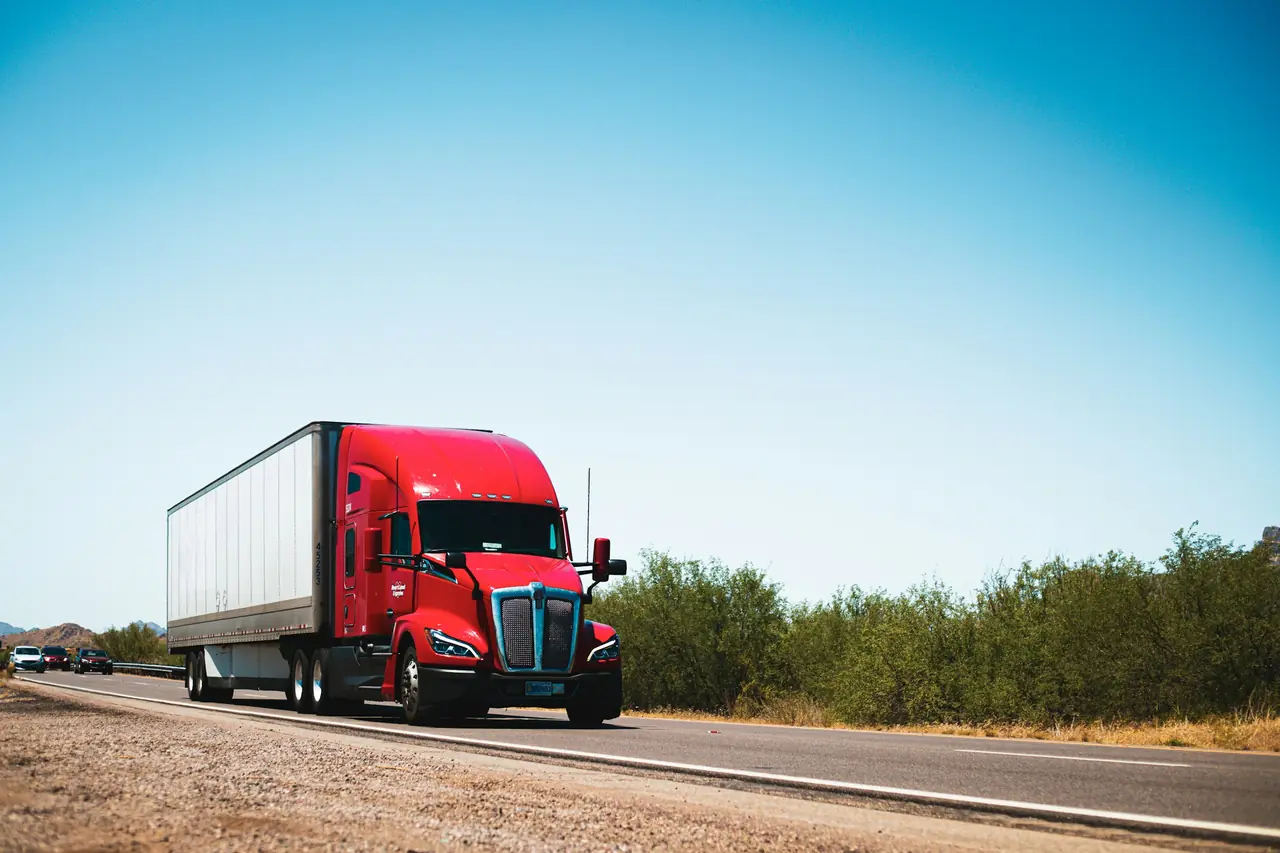
What full truckload shipping is
Full truckload shipping means you buy the whole trailer for one load. The driver backs into your dock, the van is loaded with your freight and nothing else, the doors are sealed, and the truck runs to your receiver without stopping at a terminal. Nobody else's pallets ride next to yours, and nobody unloads and reloads your freight along the way.
That is the core difference from less than truckload (LTL), where your pallets share a trailer and pass through cross docks. In LTL you pay by weight and freight class. In FTL you pay by the truck, so the price depends on the lane, the date and the equipment, not on the density of each pallet.
FTL suits shippers who fill a trailer or come close, who have freight heavy enough that sharing space makes no sense, or who cannot afford the damage and delay that come with extra handling. Retail replenishment, manufacturing inputs and packaged food are the classic cases.
Full truckload compared with other options
Choose full truckload when your freight fills most of a van, weighs too much to share space, or needs a fixed delivery appointment. Choose something else when the freight is small, temperature sensitive, oversized or extremely urgent. The table below lays out how the common options differ.
| Option | How it is priced | Handling | Best for |
|---|---|---|---|
| Full truckload (dry van) | Per truck, by lane and date | Loaded once, unloaded once | Trailer-filling or heavy palletized freight |
| LTL | By weight and freight class | Cross docked, often several times | A few pallets, flexible delivery |
| Partial | By space and weight used | Shares a truck, usually no cross dock | Loads too big for LTL, too small for a full van |
| Reefer | Per truck, plus unit operation | Loaded once, temperature held | Food and anything needing a set point |
| Flatbed or step deck | Per truck, plus tarps or permits | Loaded from side or top | Steel, lumber, machinery |
If you are between sizes, compare a partial truckload quote with the full van. Partials can be cheaper when you fill part of the floor, but the truck may make other stops, so the delivery window is looser. Freight that needs a set temperature belongs in a reefer, and anything that must be loaded by crane or forklift from the side goes on a flatbed. The usual mistake is paying LTL rates for freight that already fills half a trailer: once LTL shipments start passing through several terminals, the claims and delays usually cost more than the space you were trying to save.
Inside a 53 ft dry van
A 53 ft dry van is an enclosed box trailer with swing or roll-up rear doors, a wood or composite floor and no temperature control. The numbers below are typical figures; exact dimensions depend on the carrier and the trailer.
| Measure | Typical figure |
|---|---|
| Inside length | About 52 ft 6 in |
| Inside width | About 8 ft 2 in |
| Inside height | About 9 ft |
| Floor positions | 26 pallets straight, up to 30 turned |
| Payload | Usually 42,000 to 45,000 lb |
Multiply the inside figures and you get the cube: 52.5 ft x 8.17 ft x 9 ft comes to roughly 3,860 cubic feet. You rarely use all of it, because door frames, wheel wells on some trailers and the rear door track take a few inches here and there. In practice most vans are limited by floor space or by weight long before they run out of cube. Light, bulky freight such as empty containers or foam cubes out first; dense freight such as canned goods or bagged material weighs out with floor still showing. Check our trailer guide for the same figures on every other trailer type.
Pallet math for a dry van
The standard 26 and 30 pallet counts come from simple division, using the 48 x 40 in GMA pallet (opens in a new tab), the most common size in the US.
- A 53 ft trailer is 636 in long (53 x 12).
- Loaded straight, the 48 in side runs along the trailer: 636 / 48 = 13.25, so 13 rows.
- Two pallets fit side by side (40 + 40 = 80 in across), so 13 x 2 = 26 pallets.
- Turned, the 40 in side runs along the trailer: 636 / 40 = 15.9, so 15 rows.
- Two across is now 48 + 48 = 96 in, inside a width of about 8 ft 2 in (98 in), so 15 x 2 = 30 pallets.
The inside length is closer to 52 ft 6 in, or 630 in, and the row counts come out the same: 13 straight, 15 turned. Turning only works if pallets are true to size. One pallet with overhang or a bulged carton can stop the last row closing. Run your real dimensions through the pallet planner before you promise a count.
Weight and size limits that apply
Every truckload on the Interstate runs under the same federal ceilings. The federal gross limit is 80,000 lb (opens in a new tab) for the whole truck: tractor, trailer, fuel, driver and freight. Within that, a single axle may carry 20,000 lb and a tandem axle 34,000 lb, and the bridge formula in the same section can require a lower gross depending on how many axles there are and how far apart they sit.
Width is 102 inches (opens in a new tab) on the National Network, and no state may set it higher or lower. There is no federal height limit; states set it, and FHWA reports a range of 13.6 to 14.6 feet. States may not limit a semitrailer to less than 48 ft, which is why 53 ft vans run freely on most routes.
The practical point is axle balance. A load of 44,000 lb can be legal on gross weight and still overload the drive tandem if the heaviest pallets sit in the nose. Spread dense freight along the floor, and tell us when one product is much heavier than the rest.
Freight that rides in a dry van
Dry vans carry anything that stays stable at outside temperature and fits through the rear doors. The bulk of it is palletized: retail replenishment, packaged food and beverage, paper and packaging, auto parts, appliances and bagged building materials. Floor-loaded freight is the other big group, where cartons are stacked by hand from floor to ceiling to fit more pieces in the cube.
| Freight | Typical load style | Common watch point |
|---|---|---|
| Retail consumer goods | Palletized, sometimes floor loaded | Strict receiver appointments |
| Shelf-stable food and beverage | Palletized | Heavy, weighs out before it cubes out |
| Manufacturing parts | Palletized or crated | Mixed weights, axle balance |
| Bagged building materials | Palletized | Dense, often a 26 pallet floor at full weight |
What stays out of a dry van: anything that can freeze, melt or spoil in summer heat, and anything too tall, long or heavy to load through the rear doors with a forklift. If you ship for stores, see how we handle retail and consumer goods. For packaged food that does not need a set point, our food and beverage page covers sanitation and receiver rules. Plant-to-plant moves of parts and finished goods follow the same pattern: palletized, mixed weights, and a receiving dock that runs on its own schedule.
Live loads, drops and appointments
How the trailer is loaded changes the plan, the timing and sometimes the cost. A live load means the driver waits at the dock while you load. It is the default for most shippers, and it works when your dock is ready at the appointment time. A drop means the carrier leaves an empty trailer with you, you load it on your schedule, and a driver hooks it later. Drops need a carrier with spare trailers in your area, so they suit repeat freight; see our drop trailer service for how that works.
Facilities run either by appointment or first come, first served (FCFS). With appointments, a missed window can push delivery a full day. With FCFS, the wait depends on the line ahead of the driver, so tell us the receiving hours, not just the address.
Multi-stop and multi-pick loads follow the same rules at every stop. Each one adds time against the driver's clock, so each one needs a window, a contact and the pallet count coming off or going on.
Seals and load security
A sealed trailer is the simplest proof that nobody opened the doors between your dock and the receiver. You or your loader apply a numbered seal after the last pallet goes on, write the number on the bill of lading, and the receiver checks it before cutting it. If the number does not match, the receiver notes it on the delivery paperwork, and the claim starts with clean evidence.
Inside the trailer, load bars or straps keep the last rows from shifting under braking. A gap in the middle of a light load is where damage starts, so fill it or brace it.
Security also means making sure the right truck shows up. FMCSA's fraud guidance (opens in a new tab) tells shippers and brokers to confirm that the truck and trailer at pickup match the contracted carrier, and warns about double brokering, where a carrier passes a load to someone else without the shipper's or broker's knowledge. Check the name on the door and the trailer number against your paperwork before loading.
Planning transit time
Transit time on a truckload comes down to road miles and the driver's legal hours. Under FMCSA's hours of service rules (opens in a new tab), a driver can drive 11 hours after 10 consecutive hours off duty, cannot drive past the 14th hour after coming on duty, and needs a 30-minute break after 8 hours of driving. Time spent waiting at your dock counts against that 14-hour window.
For planning we use about 550 road miles a day for one solo driver and about 1,000 for a team. That is a rule of thumb, not a law. Here is how it works on a real lane:
| Lane | Road miles | Solo plan | Team plan |
|---|---|---|---|
| Chicago, IL to Atlanta, GA | about 715 to 730 | 2 days | 1 day |
| Houston, TX to Dallas, TX | about 240 | Same day | Same day |
Chicago to Atlanta also crosses from Central to Eastern time, so a delivery appointment loses an hour. Our Chicago to Atlanta lane guide covers that run in detail, and the lane finder gives miles and transit for other city pairs. If one day matters, ask about expedited and team service.
What drives a truckload rate
A truckload rate is set by supply and demand on your exact lane on your exact day. The main factors, roughly in order of weight:
- Lane balance. A truck leaving a market with lots of outbound freight is easy to reload; one going somewhere with little outbound freight may run home empty, and the rate carries that trip.
- Distance. Longer runs cost more in total, though usually less per mile than short runs, where dock time eats more of the driver's day.
- Equipment availability. Dry vans are the most common trailer, but local supply still tightens around holidays, storms and quarter ends.
- Seasonality. Harvest and retail peaks pull trucks toward growing regions and distribution centers.
- Lead time. A day or two out gives the widest choice of trucks. Same day freight is priced to the market that morning.
- Stops and timing. Every extra stop, tight window or weekend delivery reduces what else the driver can do that week.
Accessorials that change the bill
An accessorial is any charge on top of the line haul rate. Most surprises on a truckload invoice come from these, and nearly all of them can be predicted at quote time if you share how your docks really run.
| Accessorial | What triggers it | How to avoid or plan for it |
|---|---|---|
| Detention | Driver held past the free time at pickup or delivery | Load on time; tell us real dock times |
| Lumper | Receiver requires a third-party crew to unload | Ask the receiver; include it in the quote |
| Driver assist | Driver helps load or unload | Say so up front; not every driver will |
| Extra stop | Each pick or drop beyond the first | List every stop when you quote |
| TONU | Truck ordered, not used (load cancelled late) | Cancel as early as you know |
| Layover | Driver held overnight for a missed or moved appointment | Confirm appointments before dispatch |
Detention is the one that grows quietly. Free time at each stop is set on the rate confirmation, and every hour past it is billable because the carrier is losing the next load. Lumper fees are set by the receiver, not the carrier, and are usually paid at the dock and reimbursed, so the driver needs to know the payment method before arrival. A cancelled load after the truck is dispatched usually means a TONU, because the carrier turned down other freight to take yours.
Our pricing is all in, with accessorials spelled out up front, so these lines should be agreed before pickup, not discovered on the invoice.
What to send for a quote
The fastest way to an accurate rate is a complete request. Missing details come back later as accessorials. Send:
- Pickup city, state and ZIP, and the delivery city, state and ZIP.
- Pickup date, and whether it is firm or flexible by a day.
- Appointment or FCFS at each end, with hours.
- Every extra stop, in order, with its window.
- Commodity, total weight and pallet count (or piece count if floor loaded).
- Pallet size, and whether pallets can be turned or stacked.
- Live load or drop, and live unload or drop at the receiver.
- Lumper, driver assist or special unloading rules at the receiver.
- Seal requirements and any security instructions.
- Whether the load repeats, and how often.
If you are not sure how many pallets fit or what the load weighs per pallet, run it through the pallet planner before you call. A repeating load can also be priced as a dedicated lane program rather than load by load. A quote costs nothing and there is no obligation to book.
How Powerhaul runs a full truckload
When the load fills the trailer or cannot share space, it rides alone. We book a van that is on time for the pickup, keep the carrier and you on the same page through delivery, and close the load out with a signed POD and a clean invoice. The signed proof of delivery and the invoice arrive together as soon as the load delivers.
You get one contact. The person who books your load is the one who answers when it changes, from the rate to the final paperwork. The rate comes from a person who prices your lane, not a formula.
Every carrier is verified against FMCSA records, insured, and approved by our compliance team before it sees a load. For multi-stop work, tell us every stop, the order and the appointment windows, and the rate covers all of it up front. We handle palletized and floor-loaded freight, live loads and drops, appointment and FCFS facilities, driver assist and lumper loads, and seal and security requests.
Common problems and how to avoid them
Most truckload problems start before the truck arrives. These are the ones we see most, and the fix for each.
- The count does not fit. Thirty turned pallets need true 48 x 40 in footprints. Measure overhang and plan with real dimensions.
- The load is legal on gross but heavy on an axle. Spread dense pallets along the floor instead of stacking them in the nose.
- The driver waits for hours. Detention starts when free time ends. Give real dock hours and stage the load before the appointment.
- The receiver needs a lumper nobody planned for. Grocery and retail distribution centers often require one. Ask the receiver and put it on the quote.
- The appointment was never made. A load without a delivery appointment can sit a day. Confirm who books it.
- The wrong truck shows up. Match the carrier name and trailer number to the rate confirmation before loading.
- Freight shifts in transit. Brace partial rows with load bars or straps.
Each of these costs money only after pickup; all of them cost nothing to fix before it.