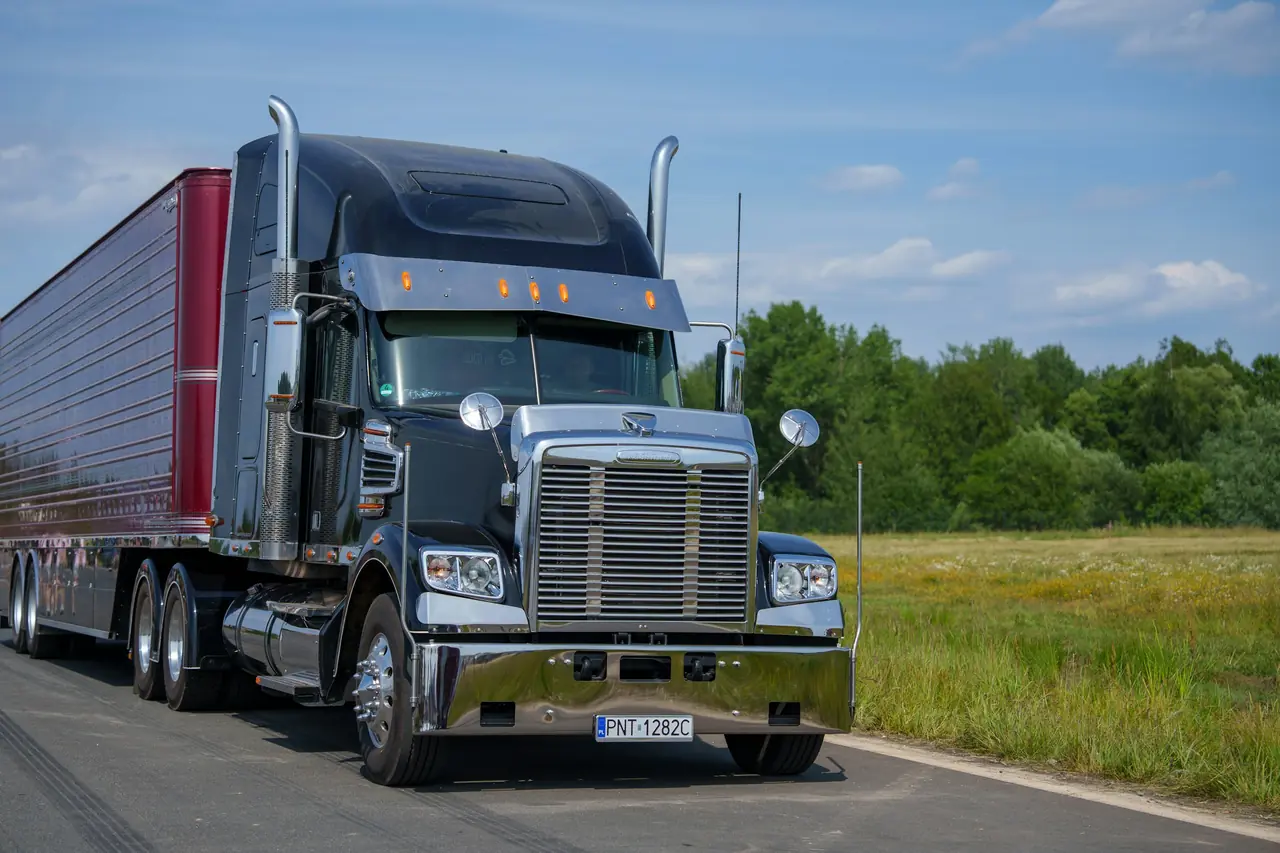
What food freight looks like on the road
Food and beverage freight is mostly palletized, high in weight, and bound for a dock that runs on a schedule. A typical load is 22 to 26 pallets of something like frozen chicken thighs out of a protein plant in north Georgia, cases of yogurt from a dairy in Wisconsin, or canned sparkling water from a bottler in Ohio. Most of it ends at a grocery distribution center, a food service warehouse, or a cold storage facility, not at a store. The freight splits into three groups. Frozen product (ice cream, frozen vegetables, meat) needs a reefer holding well below freezing. Fresh and chilled product (dairy, deli, eggs, juice) needs a reefer holding just above freezing. Shelf stable product (cereal, snacks, canned goods, bottled drinks) rides in a clean dry van most of the year. Each group has a different failure mode, but all three share one buyer expectation: arrive inside the window, at the right temperature, in a trailer that would pass a sniff test.
Matching trailers to food commodities
The commodity decides the trailer, and the receiver decides how clean it has to be. Use the table as a starting point, then check the receiver's routing guide.
| Commodity | Trailer | Watch for |
|---|---|---|
| Frozen meat, ice cream, frozen vegetables | 53 ft reefer, continuous mode | Unit pre-cooled to the shipper's set point before loading |
| Dairy, eggs, deli, fresh juice | 53 ft reefer, continuous mode | Freezing at the nose of the trailer if air flow is blocked |
| Cereal, snacks, canned goods | 53 ft dry van | Odor, moisture and floor damage from the last load |
| Bottled water, soda, beer | Dry van, or reefer on heat in winter | Weight limits before pallet count |
| Repeat outbound from one plant | Drop trailer | Trailer cleanliness checked before each load |
A typical 53 ft reefer runs about -20 F to 70 F and carries 42,000 to 44,000 lb. A typical dry van carries 42,000 to 45,000 lb.
The FSMA sanitary transport rule
The FDA's sanitary transportation rule (opens in a new tab) (21 CFR Part 1, Subpart O, under the Food Safety Modernization Act) is the federal rule that governs how food moves by truck. Its aim is simple: food should not become unsafe during transport because of poor temperature control, contamination from a previous load, or a dirty trailer. It does not dictate a particular reefer brand or a single temperature for every product. Instead it assigns duties by role and requires that the important ones be written down. The rule covers shippers, loaders, motor carriers, rail carriers and receivers. A broker arranging the move is not loading or hauling, but a good broker makes sure the paperwork carries what the rule needs. One exemption matters for beverage shippers: food fully enclosed in a container, such as canned soda or bottled water, is exempt unless it needs temperature control for safety. Chilled juice in sealed bottles still needs temperature control, so it stays in scope.
Who does what under FSMA
Each party on a food load has a specific job under the rule. The FDA's summary of key requirements (opens in a new tab) breaks it down this way.
| Role | Duty under the rule |
|---|---|
| Shipper | Gives the carrier the operating temperature in writing, including pre-cooling, for food that needs temperature control |
| Loader | Confirms the refrigerated compartment is pre-cooled before loading; can delegate this to the carrier by written agreement |
| Carrier | Pre-cools as specified and, on request, shows the temperature was maintained, by a method agreed in writing |
| Receiver | Checks the load for signs of significant temperature abuse |
Written agreements are kept for 12 months after they end. In practice the shipper's instructions usually reach the carrier on the rate confirmation, which is why the set point belongs there and nowhere vaguer.
Temperature records and set points
The set point is a number the shipper states, not one the driver picks. A reefer load sheet should give the set point in degrees Fahrenheit, the mode, and any product temperature range the receiver will check. Continuous mode runs the fan all the time and holds a tighter range, which is what most fresh and chilled food needs. Cycle mode lets the unit shut off between cooling cycles to save fuel, which some frozen shippers allow. The rule says the carrier must show, on request, that the temperature was maintained, and the method is agreed in writing. Common methods are ambient air readings at load and unload, or a download of time and temperature data from the reefer unit. Ask for the download method you want before the load books, because a receiver who suspects temperature abuse will ask for it at the dock, and that is too late to set it up. Keep the download with the bill of lading so the record and the shipment travel together.
Grocery DC appointments
Grocery distribution centers run on appointments, and the appointment is part of the order. A national chain's warehouse outside Atlanta or Dallas may receive trailers at every door from early morning to late night, so each inbound load gets a slot, and the receiving schedule is built around it. A truck that arrives early may wait. A truck that arrives late may be turned away, rescheduled for another day, or charged a fee under the retailer's vendor compliance program. Some warehouses run first come, first served for certain freight, but most food loads into large chains are booked to a time. The appointment is usually made by the shipper, the consignee, or the broker through the retailer's scheduling system, and the purchase order number is the key to it. When a load is running late, call the receiver before the slot passes. A reschedule made early is a nuisance. A no show logged by the receiving desk becomes a compliance mark against your account.
Lumpers and unloading at the dock
Many grocery receivers use a third party unloading crew, called a lumper, and the carrier or shipper pays for the service at the dock. The driver backs in, the crew breaks down or restacks pallets to the warehouse's standard, and the driver pays by card, check or a payment code, then gets a receipt. The fee varies by facility and by how the freight is loaded, and floor loaded cases cost more to unload than clean pallets. Two things go wrong with lumpers. The first is money: nobody agreed who pays, so the driver refuses or the invoice gets disputed weeks later. The second is time: a slow crew can hold a truck at the door for hours, which leads to a detention charge. Settle both before the load ships. State on the rate confirmation who pays the lumper, how the receipt gets submitted, and when detention starts.
Why receivers reject food loads
A receiver refuses a food load when accepting it would put the product, the buyer or a food safety audit at risk. The usual reasons fall into five groups. Temperature: the product or the air reads outside the range on the purchase order, or the reefer record shows a gap. Condition: pallets are crushed, leaning, wet or shrink wrap is torn, so the receiver cannot be sure the product inside is sound. Sanitation: the trailer smells of the last load, has debris on the floor, or shows pest activity. Timing: the truck missed the appointment and the receiver has no door. Paperwork: the bill of lading, the purchase order and the case count do not match. A rejection is expensive in a specific way. The product is already on a truck far from home, the carrier needs a new destination, and perishable freight loses value every hour the decision takes. Most rejections trace back to the shipping dock, not the road.
How to prevent a rejected load
Prevention happens before the doors close. These steps cover the common causes.
- Write the set point, mode and product temperature range on the rate confirmation.
- Pre-cool the trailer to the set point and confirm the reading before loading starts.
- Check product temperature at loading and note it on the bill of lading.
- Inspect the trailer for odor, debris, moisture and floor damage, and refuse a dirty one.
- Load pallets tight, with airflow space at the nose and the rear doors of a reefer.
- Match the case count, purchase order number and lot codes on every document.
- Book the appointment early and give the carrier the confirmation number.
The two steps shippers skip most are the trailer inspection and the product temperature at loading. Without a loading temperature on record, a warm load at the receiver turns into an argument with no evidence on either side. A note on the bill of lading costs a minute and settles that argument.
Weight and pallet limits for food
Food loads usually run out of weight before they run out of floor. A 53 ft trailer is 636 in long. With 48 x 40 in pallets (opens in a new tab) loaded 48 in side along the trailer, 636 / 48 = 13 rows, times 2 across, is 26 pallets. Turned, 636 / 40 = 15 rows, times 2, is 30 pallets in a dry van. Now the weight: if each pallet of canned drinks weighs 2,000 lb, 22 pallets is 44,000 lb, already at the top of a typical reefer payload. The federal gross limit on the Interstate is 80,000 lb (opens in a new tab) for truck, trailer and freight together, with 34,000 lb on a tandem axle, so a heavy beverage load also has to be balanced front to back. Light, bulky freight like chips or cereal does the opposite and fills the floor at a fraction of the weight. Use the pallet planner to check both before you promise a count.
Seasonal surges in food freight
Food freight has a calendar, and capacity tightens when many shippers want the same trucks at once. Reefer demand climbs when spring and summer produce moves, because produce competes with protein and dairy for the same refrigerated trailers. The weeks before major holidays bring heavy outbound volume from food manufacturers stocking grocery shelves: turkeys and baking goods before Thanksgiving, beverages and snack foods before summer holidays and big sporting events. Winter adds a different problem. Beverages, sauces and anything water based can freeze in an unheated dry van crossing the northern states, so shippers move to reefers running heat, which pulls more refrigerated capacity into the market. The practical response is to plan the surge rather than react to it. Give your carrier or broker the expected volume weeks ahead, lock in repeat lanes where you can through dedicated lanes, and keep pickup times flexible on the busiest weeks.
Transit time and driver hours
Transit on a food load is set by distance and by federal driver hours, not by how fast the product spoils. Under the FMCSA hours of service rules (opens in a new tab), a property carrying driver can drive 11 hours after 10 consecutive hours off duty, and cannot drive past the 14th hour after coming on duty. A 30 minute break is required after 8 hours of driving. Our planning rule of thumb is about 550 road miles a day for one solo driver and about 1,000 for a team. Take a load of chilled dairy from Chicago to a grocery warehouse in Atlanta, about 715 to 730 road miles: two days for a solo driver, one for a team, as the Chicago to Atlanta lane guide shows. Long waits at the shipper eat into the 14 hour window, so a slow loading dock can push a delivery a full day.
What to send for a food load quote
A complete request gets a firm price and a carrier who knows what the load needs. Send these with the request.
- Pickup and delivery city, state and ZIP, with facility names if known
- Pickup date and delivery appointment, or whether the receiver books it
- Commodity, packaging and whether it is frozen, chilled or shelf stable
- Set point in degrees Fahrenheit, continuous or cycle mode, and pre-cooling instructions
- Pallet count, pallet size, total weight and whether pallets stack
- Floor loaded or palletized, and whether a lumper is expected at delivery
- Trailer requirements in the receiver's routing guide (washout, food grade, no prior loads of a certain type)
- How you want temperature proven: ambient readings, unit download, or a recorder
- Repeat volume, if this lane ships weekly
The temperature line is the one people leave off. A quote for "frozen" without a set point invites a carrier to guess, and guessing is how a load of ice cream ends up rejected at the door.
How Powerhaul handles food loads
We book carriers who know grocery DC rules, protect the cold chain and show up on the minute for the appointment. On reefer loads the set point is confirmed before the wheels turn, and temperature logs are available on request, so the record is there when a receiver asks. Food grade trailers and lumper handling are part of the plan from the start, not something sorted out at the dock. Every carrier is checked against FMCSA records before it hauls for us, and one person stays on every load from booking to delivery, so there is a single name to call if the appointment moves or the receiver raises a question. When seasonal surges hit, we plan capacity with you ahead of time. Your rate comes from a person, not a formula. Send the lane, freight and date through the quote form and we will come back with a price and a truck.