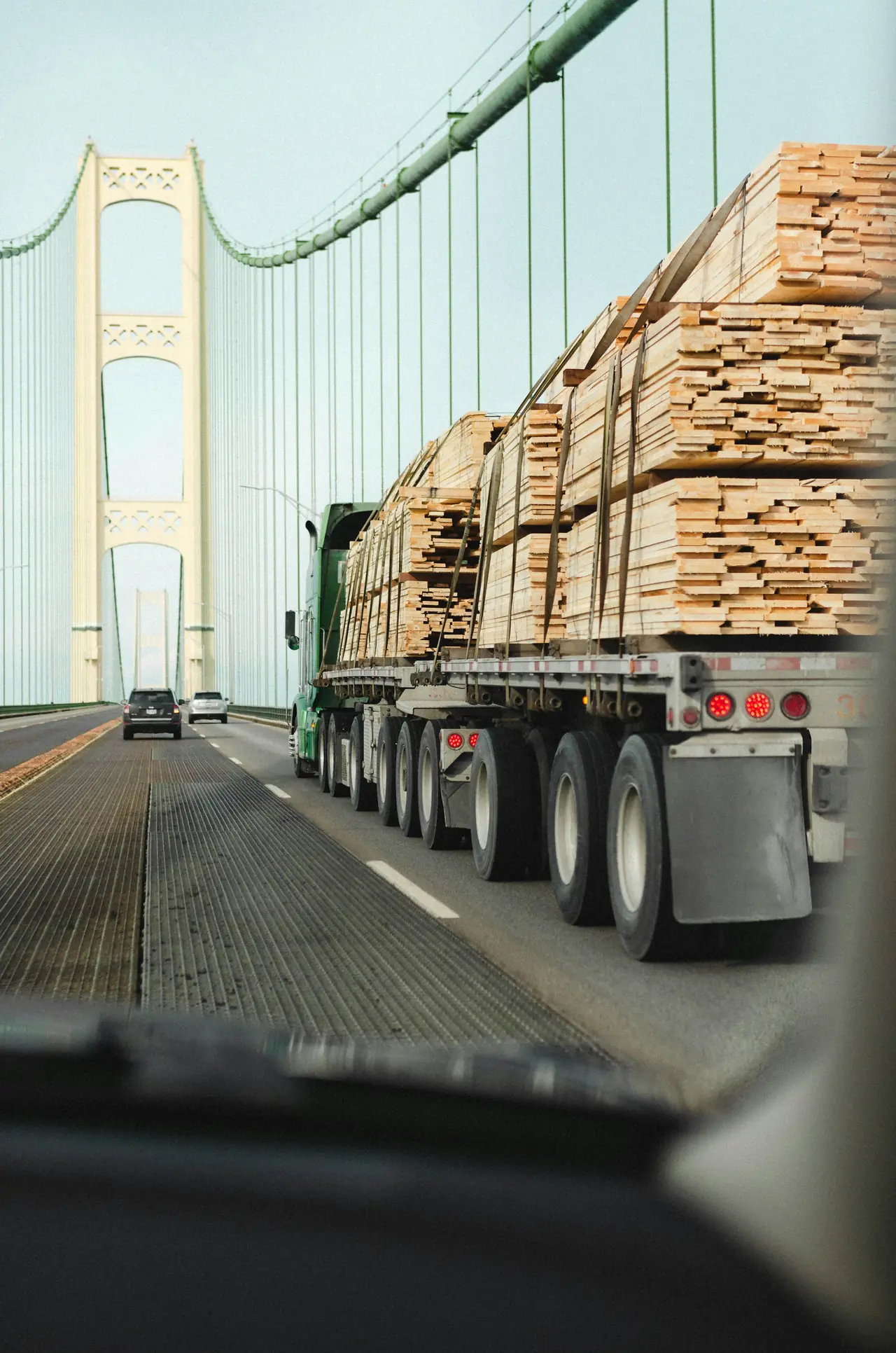
What building materials freight looks like
Building materials freight is a mix of heavy, dense products and light, bulky ones, and the mix decides the trailer. The heavy side includes dressed lumber in banded units, plywood and OSB sheathing, drywall (gypsum board), palletized asphalt shingles, concrete block and pavers, and bundles of PVC or ductile iron pipe. The light side includes fiberglass insulation, foam board, boxed doors and windows, and siding. Dense loads fill the weight limit long before the deck is full; light loads fill the space first.
Most of it moves from a sawmill, a gypsum plant or a manufacturer's warehouse to a distribution yard, a lumber yard or straight to a job site. Typical runs include studs from a sawmill in south Georgia to a building supply yard in Atlanta, block from a plant near Houston to a contractor in Dallas on the Houston to Dallas flatbed lane, about 240 miles and same-day for one driver, and palletized insulation in a van on the Chicago to Atlanta dry van lane.
Choosing the trailer for each product
The trailer depends on how the product loads, whether it can get wet and what the receiver has to unload it. A flatbed is the default for lumber, block, shingles and pipe, because yards and job sites unload from the side with a forklift. A step deck carries taller stacks, such as trusses or tall units of sheathing, since its lower deck sits about 3 ft 6 in off the road and takes freight about 10 ft tall (typical). Light, dry freight bound for a dock rides in a 53 ft van as full truckload.
Mixed loads are common and need a plan. A yard order with lumber on the front of the deck and pallets of shingles on the back has two securement methods, two tarp needs and one axle plan, so tell the carrier the full mix before the trailer is chosen.
| Product | Usual equipment | Why it fits |
|---|---|---|
| Dressed lumber, plywood, OSB | Flatbed, tarped | Side loading by forklift, tarps keep it dry |
| Drywall | Flatbed with full tarps, or Conestoga | Ruined by water, edges crush easily |
| Shingles, block, pavers | Flatbed | Dense, reaches the weight limit early |
| Trusses and tall units | Step deck | About 10 ft of freight height (typical) |
| Insulation, doors, windows | 53 ft dry van | Light, bulky, must stay dry, dock delivery |
| Weekly yard replenishment | Dedicated lanes | Same carriers know the yards |
Dressed lumber under 393.118
Dressed lumber and similar building products have their own federal securement section, 49 CFR 393.118 (opens in a new tab), which covers bundles of dressed lumber, packaged lumber and building products of similar shape, such as plywood and gypsum board. It sets how bundles loaded side by side and stacked in tiers must be tied down, so a load built three units high and two wide is secured as a system rather than one bundle at a time.
The general rules still apply on top of it. Under 49 CFR 393.110 (opens in a new tab), each article not blocked by a headerboard needs two tiedowns for the first 10 ft and one more for every additional 10 ft or fraction. A 16 ft unit of studs therefore needs 2 + 1 = 3 tiedowns. Under 49 CFR 393.106 (opens in a new tab), the working load limits of all tiedowns must add up to at least half the cargo weight, so 40,000 lb of lumber needs at least 20,000 lb of combined working load limit. Straps are the norm on lumber, with edge protectors on every top corner.
Drywall, shingles and block
These three products cause more trouble than lumber because each one fails in its own way. Drywall is heavy and fragile at the same time. A strap pulled tight across an unprotected edge crushes the board, and a single wet corner on a stack can mean the receiver rejects the whole unit, so drywall needs edge protectors under every strap and full tarps on a flatbed.
Asphalt shingles come on pallets, wrapped, and they are dense enough that a flatbed reaches its weight limit with deck space left over. In summer heat, shingle bundles can stick together if they are stacked too high or left in the sun. Concrete block and pavers ride on pallets with banding, and the pallet itself is the weak point: a cracked deck board lets the block shift. Each of these products is usually heavy enough that the load plan starts with the weight, not the pallet count, and the pallet planner helps when the load mixes products.
Tarps and keeping freight dry
Most building materials ship tarped, because water damage is the most common reason a yard refuses a load. Dressed lumber stains and swells, plywood delaminates at the edges, drywall turns to paste, and boxed doors and windows lose their cartons. Lumber tarps are large and hang low on the sides of tall stacks, and a load of tall units can take more than one tarp to cover.
Tarping adds time at the shipper and a charge on the bill, so it belongs on the order and on the rate confirmation, not as a request at the dock. A driver who arrives without enough tarps for a three-high lumber load either waits for a replacement or leaves with part of the load exposed. When freight cannot take any moisture, a Conestoga is the usual answer: it has a rolling tarp system, an inside height of about 8 ft and a payload of about 42,000 lb (typical). The trailer guide compares it with a tarped flatbed.
Job sites without docks
Deliveries to a job site succeed or fail on the unloading plan, because most sites have no dock and many have no forklift on the day the truck arrives. A flatbed driver usually does not unload; the site does, with a forklift, a telehandler or a crane. If none of those will be there, the load needs a truck-mounted forklift, a crane truck, or a different delivery date.
The site itself matters too. A 53 ft trailer needs a firm, level spot to park and room to turn around, and a soft lot after rain can strand a loaded truck. Some residential streets restrict truck access, and some sites only accept deliveries in an early morning window. Hours of service limit how long the driver can wait: a driver gets 11 hours of driving inside a 14-hour window (opens in a new tab), so a three-hour wait for a forklift that never comes leaves 14 minus 3 = 11 hours of window and can push the next load. Send a site contact who will answer the phone.
Piggyback forklifts for no-equipment sites
A truck-mounted forklift, often called a piggyback forklift or a Moffett after the best-known maker, is a compact forklift that rides on the back of the trailer. At the site the driver lowers it to the ground, unloads the freight alone and hangs it back on the trailer. It is the standard answer when a lumber yard sends a load to a job site with no equipment and nobody to run it.
The practice has trade-offs you should plan for. The forklift adds weight to the truck, so it reduces how much freight the trailer can legally carry on the same 80,000 lb gross. Fewer carriers run them, so the truck may come from farther away. Forklifts of this kind need firm ground and can struggle in deep mud or on steep grades. The order should say where each unit goes, such as the curb, the garage pad or a staging area. Ask for it by name when you request the quote, because it cannot be added after dispatch.
Loads near the legal maximum
Building materials regularly push the legal weight limit, so the axle plan matters as much as the total. Under 23 CFR 658.17 (opens in a new tab), the federal Interstate limit is 80,000 lb gross, 34,000 lb on a tandem axle group and 20,000 lb on a single axle, and the bridge formula can lower the gross depending on axle count and spacing. A typical flatbed carries up to about 48,000 lb of freight, and a typical 53 ft dry van about 42,000 to 45,000 lb.
Dense products such as block, pavers, shingles and treated lumber reach those figures with deck space to spare, so a load that looks half empty can be fully legal and fully loaded at once. The order needs an honest scale weight, not an estimate from a quote sheet. If the shipper's weight is off by a few thousand pounds, the truck may scale heavy on its drive axles and have to shift or drop freight before it can leave. Loads near the limit also leave no room for a piggyback forklift.
Timing and seasonality
Building materials follow the construction calendar, which follows the weather. Demand for flatbeds hauling lumber, block and roofing climbs in spring as builders restart, stays high through summer and slows in the colder months across the northern states, while southern markets build year round. Storm seasons add sudden spikes: after a major hurricane or hail event, roofing materials and plywood move toward the affected region in a hurry, and flatbed capacity tightens with them.
Daily timing matters just as much. Lumber yards and gypsum plants often load early, and job sites often want freight before crews start, so a truck may need to pick up the day before and stage nearby. Roadside enforcement also has a season. CVSA runs International Roadcheck each spring, and the 2026 event ran May 12 to 14 with cargo securement as the vehicle focus (opens in a new tab), which put every strap on a tarped lumber load under a closer look.
How building materials loads go wrong
Building materials claims tend to come from the same few gaps between what the shipper knew and what the driver was told. Each one has a simple prevention.
- Nobody to unload. The truck arrives at a job site with no forklift. Prevent it by confirming equipment and a site contact before booking, or by ordering a truck-mounted forklift.
- Water damage. Drywall or plywood arrives wet. Prevent it by putting the tarp requirement in writing and choosing a Conestoga or van for anything that cannot take moisture.
- Crushed edges. Straps cut into drywall or sheathing. Prevent it by requiring edge protectors.
- Heavy on the drives. Block or shingles loaded too far forward. Prevent it with honest weights and a load plan.
- Truck cannot reach the site. Soft ground or restricted streets. Prevent it with a site description and a backup drop point.
- Detention at the yard. The truck waits hours to load. Prevent it with confirmed appointments.
What to send for a quote
A building materials quote depends on the unloading plan as much as the miles, so the details below change the price and the truck. Send them with the request.
- Pickup and delivery city and state, and whether delivery is a yard with a dock, a yard without one, or a job site.
- Pickup date, delivery window and site hours.
- Products and quantities: units of lumber, pallets of block or shingles, sheets of drywall.
- Total weight and, if possible, the weight of the heaviest unit.
- Lengths of the longest items, such as 16 ft or 20 ft lumber.
- Tarp requirement, and whether any product cannot get wet at all.
- Unloading equipment at delivery, or a request for a truck-mounted forklift.
- A site contact name and phone number.
If you are unsure whether a flatbed or a van fits, describe the freight and the receiver and let us suggest the trailer. The quote form takes the lane, date, equipment, weight and commodity, and the notes field takes the rest.
How Powerhaul handles building materials
We sort out the unloading plan, the securement and the site contact before the truck shows up. That is the whole point of booking building materials through a person instead of a load board: the questions about the forklift, the tarps and the soft lot get asked on the phone, not at the gate.
We book building materials on flatbeds and step decks for tarped lumber, job site deliveries and distributor yard runs, on 53 ft vans for dock-to-dock freight, and on dedicated lanes for yards that restock every week. When a site has no equipment, we arrange forklift or Moffett unloading with a carrier that runs one. Heavy loads near the legal max get their weights checked before dispatch. Every carrier is verified against FMCSA records, insured and approved by our compliance team before it sees a load, and one person owns your load from booking to delivery. If the same customer also buys rebar or structural steel, the steel and metals page covers those loads.